- Outsourcing to India means hiring Indian companies or professionals to handle IT, software development, accounting, customer support, or back-office operations at 50-70% lower labor costs than US hiring.
- India commands 56% of the global business process outsourcing market and remains the top global hub for IT services and software development.
- Top benefits: 50-70% cost savings, access to 5.95 million skilled workforce, 24/7 operations through the time zone advantage, and strong English proficiency.
- Seven main Indian cities lead the outsourcing industry, Bangalore, Hyderabad, Pune, Chennai, Mumbai, Delhi NCR, and Kolkata, each with different specialized skills.
- Four models to choose from: set up a legal entity, hire through an Employer of Record (EOR), use staff augmentation, or partner with a managed services provider.
- Global companies outsourcing to India include Microsoft, Google, Amazon, JP Morgan, Walmart, and Deloitte, with 1,700+ Global Capability Centers employing 1.9 million Indian professionals.
- Real 2026 risks are DPDP Act data protection liability, Permanent Establishment tax exposure, IP ownership gaps, and 13-17% annual IT attrition, all manageable with the right partner.
Ready to outsource to India the right way? Contact us today!
Discover how we create impactful content.
Is outsourcing to India worth it in 2026? Yes, and the math has never been clearer for US companies.
From helping 300+ global companies build teams in India and processing $20M+ in payroll, we've watched the work shift from call centers to AI engineering and cloud architecture. India's IT/BPM sector crossed $300 billion for the first time in FY2026, hitting $315.4 billion in revenue, and still commands 56% of the global business process outsourcing market. (Source: Wisemonk India IT Services Analyst Report 2026)
About the HIRE Act noise, it's a real bill (S.2976), but it's stalled in committee with zero co-sponsors. The February 2026 US-India trade framework actually cut tariffs to 18% and deepened cooperation on data centers. The direction of travel is collaboration, not restriction.
The work itself has moved up the value chain too. 74% of new IT contracts now include an AI component, up from 31% in FY24, backed by $250 billion in AI infrastructure commitments from Reliance, Adani, Microsoft, AWS, and Google combined. (Source: Wisemonk India Investment Intelligence 2026)
This guide covers what outsourcing to India means in 2026, why US companies choose it, what it costs, which services and cities work best, who's already doing it, and how to start without the compliance mistakes we see most often.
Let's start with the basics.
What is outsourcing to India?[toc=Outsourcing to India]
Outsourcing to India means hiring Indian companies or professionals to handle specific business functions so you cut costs, tap into specialized skills, and scale faster without building everything in-house.
Instead of hiring locally in the US, you hand off work like software development, accounting, customer support, or data entry to an Indian service provider or offshore team. Same quality, fraction of the cost, 25+ years of proven success serving global clients.
From our experience helping 300+ global companies make the move, outsourcing work in India falls into three clear buckets.
- ITO (IT outsourcing): Software development, cloud migration, cybersecurity, DevOps, and technical support. India's IT services sector employs 5.95 million tech professionals, the largest pool outside the US and China. (Source: Wisemonk India IT Services Analyst Report 2026)
- BPO (business process outsourcing): Customer support, data entry, payroll processing, bookkeeping, and back-office operations. Indian companies handle 56% of the world's BPO work.
- KPO (knowledge process outsourcing): Data analytics, financial research, tax preparation, legal services, and AI development. Fastest-growing segment of India's outsourcing industry, powered by 2.5 million STEM graduates India produces every year.
The shift is real. A decade ago, most outsourcing work was repetitive back-office tasks. Today, Indian professionals run AI Centers of Excellence, build enterprise-grade cloud platforms, and handle complex financial modeling for Fortune 500 clients. India houses 120,000+ AI/ML professionals across 185+ dedicated AI Centers of Excellence within GCCs. (Source: Wisemonk India Investment Intelligence 2026)
That's the "what." Next up, why US companies keep picking India over every other outsourcing destination.
Why do companies outsource to India?[toc=Benefits]
US companies outsource to India because no other destination delivers the same mix of cost savings, talent depth, and operational maturity. It's not one advantage, it's six, stacked.
Having guided companies across SaaS, fintech, healthcare, and e-commerce through this decision, here are the drivers we see every single time.
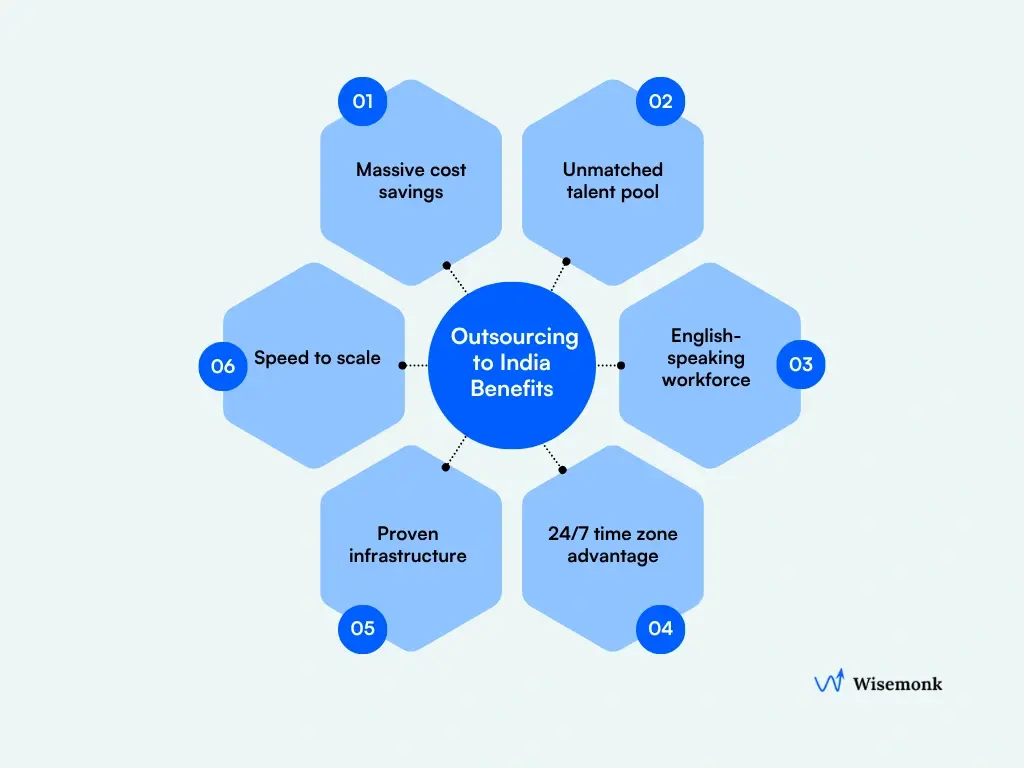
- Massive cost savings: Labor costs run 50-70% lower than the US for equivalent roles. A mid-level developer who costs $120K in San Francisco costs $25K-$40K in Bangalore, with no compromise on quality.
- Unmatched talent pool: India produces 2.5 million STEM graduates annually, second-highest globally after China. The IT/BPM workforce sits at 5.95 million professionals, with 20+ lakh already upskilled in AI. (Source: Wisemonk India IT Services Analyst Report 2026)
- English-speaking workforce: India has 129 million English speakers, the world's second-largest. Most Indian professionals have years of experience serving US and UK clients, so communication friction is minimal.
- 24/7 time zone advantage: The 9.5-12.5 hour difference means your US team logs off, your India team takes over. Tickets close overnight, code ships before you're back at your desk.
- Proven infrastructure: India has 25+ years of serving global clients. Modern data centers, ISO 27001-certified providers, DPDP Act 2025 data protection, $1.2 billion IndiaAI Mission, and a 20-year tax holiday framework for data centers.
- Speed to scale: Through an Employer of Record, you can onboard a compliant India team in 48 hours. Setting up your own entity takes 3-6 months. EOR is the shortcut most startups use to test India before committing.
Here's the clearest signal of India's pull, over 1,700 Global Capability Centers now operate there, employing 1.9 million professionals and generating $64.6 billion in revenue, contributing over 1% of India's GDP. Microsoft, Google, Amazon, JP Morgan, and Walmart all run some of their largest offshore units from Indian cities. (Source: Wisemonk India Investment Intelligence 2026)
For the full data breakdown behind each of these drivers, read our deep-dive on why companies outsource to India.
One more thing worth noting. 74% of new IT contracts in India now include an AI component, up from just 31% in FY24. This isn't your parent's outsourcing story. It's where the work is actually being done now.
"The Indian technology services sector can utilize the potential of deep technologies like cloud, artificial intelligence, and machine learning to contribute significantly to the global economy."
- Debjani Ghosh, President of NASSCOM (Strategic Review 2025)
And if you want to see how these cost savings translate into business value, check out the complete benefits of outsourcing to India.
Ready to see who's already doing this? Let's look at the companies outsourcing to India today.
Which companies outsource to India?[toc=Companies Outsourcing to India]
From Fortune 500 giants to Series A startups, everyone's building in India. Over 1,700 companies now run Global Capability Centers there, employing 1.9 million professionals. (Source: Wisemonk India Investment Intelligence 2026)
Here's who's leading, by category:
- Big Tech: Microsoft, Google, Amazon, Apple, Meta, IBM, Oracle, Intel, Nvidia, backed by $17.5B (Microsoft), $15B (Google), and $7B (AWS) in India cloud and AI commitments.
- Financial services: JP Morgan, Goldman Sachs, Morgan Stanley, Citigroup, Wells Fargo, Bank of America, HSBC, American Express, Standard Chartered.
- Retail & industrial: Walmart (25,000+ engineers in India), Target, Ford, GE, Siemens, Unilever, P&G.
- Consulting: Deloitte, Accenture (300,000+ in India alone), PwC, KPMG, EY.
- Startups & scaleups: Most Series A-C SaaS and AI companies now build engineering teams in India through EOR providers, the fastest-growing segment of India's outsourcing industry.
The pattern is clear. Whether you're a 20-person startup or a Fortune 500, India is where work gets done. The question isn't whether to go, it's which model fits.
Speaking of which, let's break down what it actually costs.
How much does outsourcing to India cost in 2026?[toc=Outsourcing to India Costs]
Outsourcing to India costs 50-70% less than equivalent US hiring. The exact number depends on the role, experience level, city, and engagement model you choose.
Here's what we see across the companies we support with payroll and hiring in India.
Prefer hourly rates? Here's the same view by the hour.
Tier-1 vs Tier-2 cities. Salaries in Bangalore and Hyderabad climb 8-10% annually thanks to AI and cloud demand. Tier-2 cities like Coimbatore, Kochi, and Jaipur run 15-20% lower, with better retention. (Source: Wisemonk India Investment Intelligence 2026)
What affects your total cost. Onboarding, project management, knowledge transfer, and quality rework typically add 20-30% to initial estimates. Factor in 2-3 hours of daily overlap, collaboration tools, and occasional travel for alignment.
Engagement model shapes the bill. EOR charges a flat monthly fee per employee (Wisemonk starts at $99/employee/month). Staffing agencies add a 20-40% markup on base rates. Managed services use project pricing or monthly retainers.
For a detailed breakdown of what you'll actually pay, read our guide on the cost of outsourcing to India.
Want exact numbers for your specific roles? Run them through our Employee Cost Calculator or EOR vs Entity Calculator.
Now let's break down what you can actually outsource to India.
What services can you outsource to India for business growth?[toc=Services Outsourced to India]
India's outsourcing industry has moved way beyond call centers. Today, US companies outsource everything from AI engineering to back-office ops, all backed by 5.95 million tech professionals and 2.5 million STEM graduates every year. (Source: Wisemonk India IT Services Analyst Report 2026)
Here's what US companies outsource most often.
1. Software development.
Indian developers build custom software, mobile apps, SaaS platforms, and enterprise systems at 60-70% lower cost than US teams.
India now houses over 120,000 AI/ML professionals across 185+ dedicated AI Centers of Excellence, and roughly 70% of GCCs have already defined an AI roadmap. (Source: Wisemonk India Investment Intelligence 2026). Read our software development outsourcing guide.
2. IT services and technical support.
This covers cloud migration, cybersecurity, infrastructure management, DevOps, and 24/7 helpdesk across AWS, Azure, and GCP.
Your US team can wrap up for the day while your India team keeps tickets moving, which is exactly why round-the-clock coverage is one of the biggest wins here. Explore the top IT outsourcing companies in India.
3. Customer support and call centers.
India delivers multilingual, 24/7 support across phone, email, chat, and social media, with consistently strong customer satisfaction scores.
Indian BPO firms handle 56% of the world's business process outsourcing workload, which says a lot about the maturity of this category.
4. Finance, accounting, and payroll.
Teams in India manage your monthly close, AP/AR, tax preparation, and US GAAP or IFRS reporting, along with fully compliant payroll including PF, ESI, and TDS.
Companies typically save 50-60% on accounting outsourcing without any drop in accuracy. For the full breakdown, read our guide on outsourcing bookkeeping to India.
5. Digital marketing and SEO.
Indian teams handle content strategy, paid advertising, SEO, and social media management with a clear focus on measurable growth for Western clients.
They work on the same tools your US team does, including Google Ads, Meta Business Suite, HubSpot, and Semrush, which keeps collaboration simple.
6. HR operations and recruitment.
Scope includes end-to-end talent acquisition, onboarding, performance management, and HR operations for distributed teams.
If this is your focus area, explore HR outsourcing and recruitment process outsourcing.
7. Data analytics and AI/ML.
This includes BI dashboards, predictive analytics, market research, and full-stack AI development using Tableau, Power BI, and Python.
74% of new IT contracts in India now include an AI component, up from just 31% in FY24, which shows how fast the work has moved up the value chain. (Source: Wisemonk India IT Services Analyst Report 2026)
8. Data entry, content, and creative work.
Indian teams deliver high-volume digitization, CRM updates, and database management at 99%+ accuracy, along with SEO content, whitepapers, explainer videos, and motion graphics.
Thanks to the time zone difference, work typically gets handed off at the end of the US day and is ready for review by the next morning.
For a full breakdown by function, read: What services can be outsourced to India?
Industry leaders are now outsourcing cloud architecture, strategic consulting, and GenAI development, which goes well beyond traditional labor arbitrage.
Next up, which Indian cities are best for which kind of outsourcing work.
Which cities in India are best for outsourcing and global delivery centers?[toc=Choosing Indian Cities]
India's outsourcing strength is spread across seven major cities, each with its own specialty. The right city really depends on the function you are outsourcing, not just the cost.
Here is a quick snapshot of what each city does best, based on our experience helping 300+ global companies set up teams across India.
Bangalore is still the default for technical work and accounts for roughly 42% of India's IT exports, with nearly 2 million software developers. Hyderabad comes next as India's second-largest IT exporter, followed by Pune and Chennai for engineering and SaaS, and Mumbai and Delhi NCR for financial services work.
Tier-1 vs Tier-2 cities. Salaries in Bangalore and Hyderabad have been climbing 8-10% annually, largely because of rising demand for AI and cloud skills. Tier-2 cities like Coimbatore, Kochi, Jaipur, Ahmedabad, and Indore run 15-20% lower on cost, with noticeably lower attrition and a growing pool of skilled talent.
Southern metros still hold about 60% of India's GCC commercial space, but between 2024 and 2025, roughly 110 new GCCs launched in India, with more expansion reaching beyond the usual metros into tier-2 cities. (Source: Wisemonk India Investment Intelligence 2026)
For most US companies, Bangalore works best for technical work, Hyderabad for cost-efficient product engineering, and Delhi NCR for financial services. For everything else, tier-2 cities are increasingly competitive on both cost and retention.
Now that you know the "where," let's see how India stacks up against other popular outsourcing destinations.
How does India compare to other outsourcing destinations on cost efficiency?[toc=India vs. Other Outsourcing Destinations]
India leads the global services outsourcing market, but it is not your only option. We regularly help companies weigh India against the Philippines, Eastern Europe, and Latin America based on their specific business needs.
Here is how the four main destinations stack up across the factors that matter most.
When India is the right outsourcing partner. India makes the most sense if you are building a larger team of 20 or more, need 60-70% cost savings on technical roles, or want deep expertise in AI, cloud, and data analytics. It also works beautifully when the time zone difference is an advantage for round-the-clock productivity, not a barrier.
When you might consider others. The Philippines is often stronger for voice-heavy customer support, Latin America is worth looking at for real-time collaboration with US teams, and Eastern Europe fits specialized EU-compliance or fintech work.
Most companies we work with land on a hybrid approach. They rely on India for engineering and technical operations, and tap nearby regions for voice or real-time roles.
If you are weighing offshoring specifically, meaning building your own team rather than going through a vendor, read our complete offshoring to India guide.
Now that you have the landscape, let's look at the different outsourcing models you can actually choose from.
What are your outsourcing to India options based on your business needs?[toc=Outsourcing to India Options]
You have two main paths: build your own team in India, or hand the work off to a service provider. The right choice comes down to how much control you want, your budget, and your long-term plans.
Here is a quick breakdown of each path.
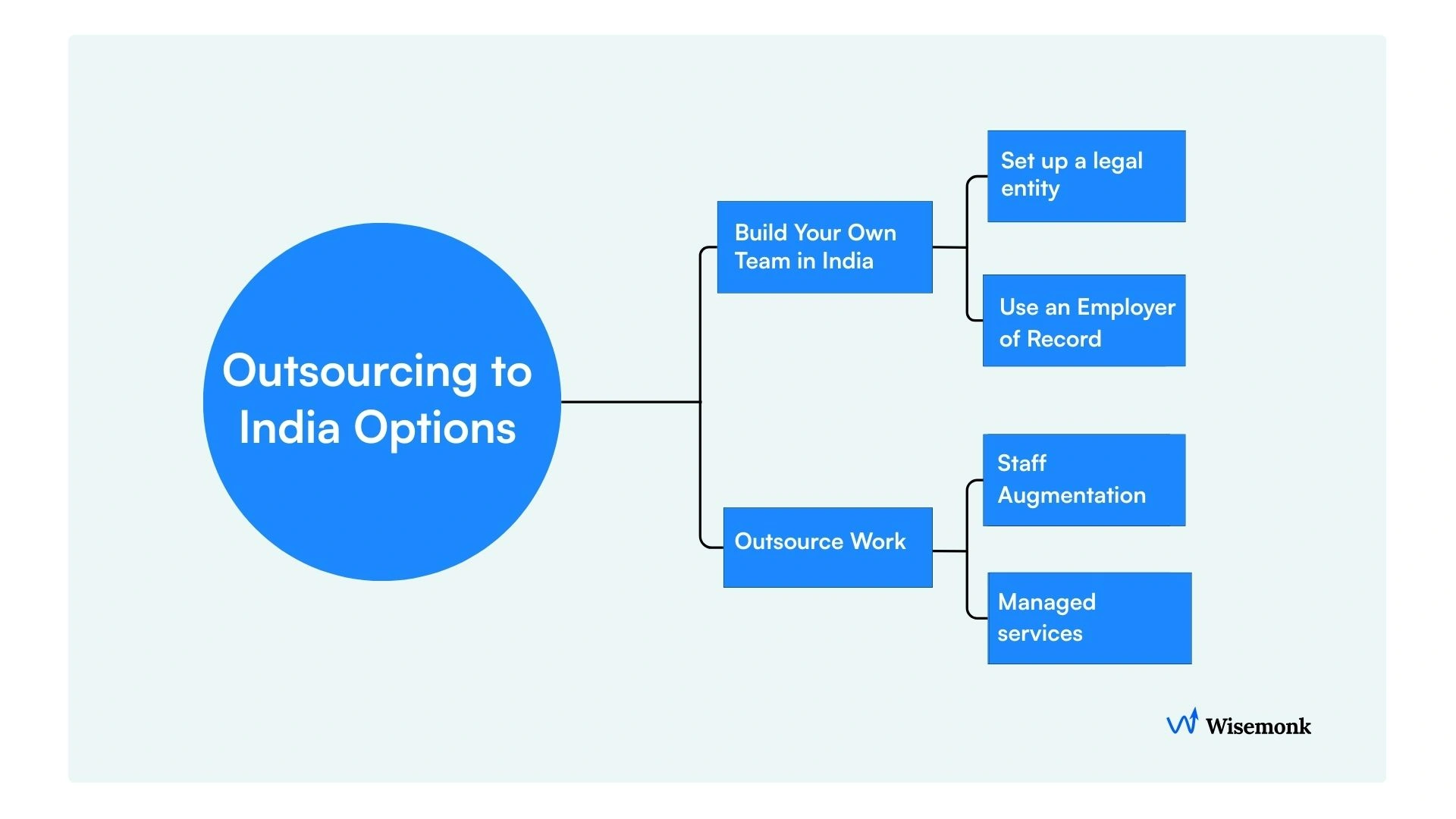
Outsourcing models for India showing four paths: legal entity setup, Employer of Record, staff augmentation, and managed services for global companies expanding business operations
Option 1: Build Your Own Team in India
In this model, the people work directly for you, follow your processes, and become part of your company culture.
- Set up a legal entity (captive center): You incorporate a subsidiary in India for 100% control over operations and hiring. It requires significant capital and 3-6 months of setup time.
- Hire through an Employer of Record (EOR): You don't set up an entity. An EOR handles payroll, taxes, and compliance while you manage the day-to-day work. You can onboard employees in 48 hours instead of six months.
For a detailed breakdown of when to use each approach, read our guide on Employer of Record vs Own Entity in 2026.
Option 2: Outsource Work to a Service Provider
Here, you are not hiring employees. You are contracting for specific deliverables or outcomes.
- Staff augmentation: Staffing firms provide dedicated talent for your projects. You direct the work, they handle payroll and HR.
- Managed services (outsourcing company): An outsourcing company takes over entire functions like customer support or software development. You define outcomes, they deliver.
Wisemonk offers flexibility across all these models, from EOR hiring to full outsourcing, enabling global businesses to operate in India without compliance complexities.
Which outsourcing model is right for you?
The model you pick shapes your compliance risk, hiring speed, and long-term control.
From our experience, most companies start with EOR to test the waters, scale the team, and then revisit the entity or GCC decision at around 30-50 employees. If you want us to help you map this to your headcount and timeline, just talk to our India team.
Next up, the step-by-step playbook to get your India operations off the ground.
How do you outsource to India step by step?[toc=Steps to Outsource to India]
The companies that succeed treat outsourcing to India as a strategic decision, not just a cost reduction exercise. From what we have seen across multiple domains, six steps separate the wins from the costly failures.
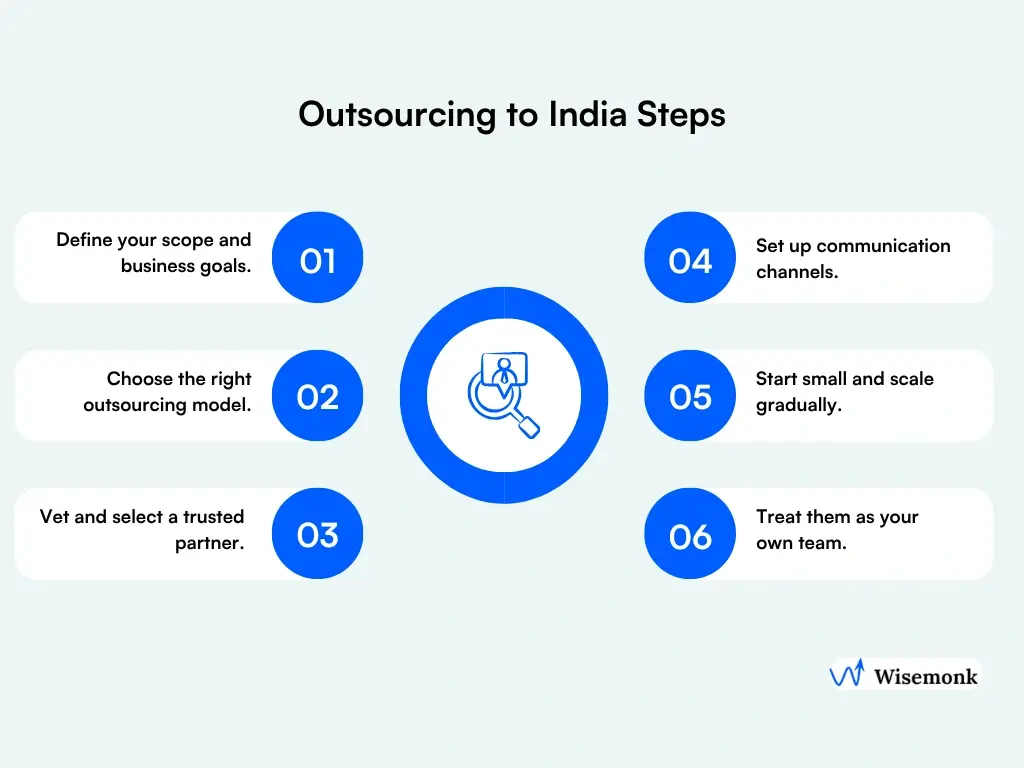
Step 1: Define your scope and business goals.
Start by identifying which business processes you want to move, whether that is software development, technical support, accounting, or customer service.
Most companies keep core strategy in-house and outsource execution-heavy or non-core work.
Step 2: Choose the right outsourcing model.
If you want full control over your offshore team, go with an EOR or staff augmentation. If you want hands-off execution, managed services is the better fit.
Your risk tolerance and management bandwidth should drive this call.
Step 3: Vet and select a trusted partner.
Do not chase the lowest price. Look for a proven track record with US clients, DPDP Act compliance for data protection, ISO 27001 or SOC 2 certification, and a strong approach to quality control.
Ask for case studies and references before signing anything.
Step 4: Set up communication channels.
Block out 2-3 hours of daily overlap where both teams are online. Indian professionals excel when communication is consistent, so use video calls over long email threads.
This one shift alone cuts project delays dramatically.
Step 5: Start small and scale gradually.
Launch with a pilot project before moving entire existing operations. Document SOPs, build feedback loops, and align your outsourced team with your standards before expanding the scope.
Indian firms are shifting rapidly from back-office support to innovation hubs, so a pilot also helps you test how well they deliver on complex tasks like RPA and machine learning.
Step 6: Treat them as your own team.
The most successful businesses view their offshore team as colleagues, not vendors.
Clear career paths, local holiday recognition, and inclusion in company events reduce attrition and help you retain top talent through genuine cultural alignment.
For a deeper walkthrough, read our guide on how to outsource work to India from the USA.
With the right approach, outsourcing to India becomes a long-term competitive advantage. But no destination is risk-free, so let's look at what can actually go wrong.
What are the risks of outsourcing to India?[toc=Risks]
The real risks in 2026 are not language barriers or time zones. They are legal, financial, political, and technological.
From 6+ years helping global companies build compliant teams, here is what actually goes wrong.
- Data protection liability. India's DPDP Act (fully enforceable by May 2027) holds you liable for vendor breaches, with penalties up to ₹250 crore (about $30M). Require ISO 27001 or SOC 2 Type II certification and a data processing agreement in every contract.
- Permanent Establishment tax risk. If your India team makes business decisions, tax authorities can classify you as having a taxable presence, triggering double taxation. An EOR solves this cleanly. Take the PE Risk Quiz if unsure.
- IP ownership gaps. Under Indian copyright law, vendors own the code unless your contract has explicit work-for-hire or IP assignment clauses. Get this in writing upfront.
- Joint employment liability. Directly controlling vendor staff can make you a joint employer liable for PF, ESI, and gratuity under Indian labor law. The EOR model eliminates this.
- Policy uncertainty. The proposed HIRE Act (S.2976) would impose a 25% excise tax on outsourcing work, but it sits stalled with zero co-sponsors as of April 2026. The Feb 2026 US-India trade framework actually cut tariffs to 18%. Low probability, but add a "change-in-law" clause to contracts.
- AI disruption of low-value work. Up to 30% of traditional outsourced tasks will be automated by 2030. India's response has been quick, 74% of new IT contracts now include an AI component, up from 31% in FY24, reflecting a clear shift from labor arbitrage to innovation hubs. (Source: Wisemonk India IT Services Analyst Report 2026)
- Skill shortage and attrition. Wage inflation has hit 10-15% as skill shortage tightens, and IT attrition sits at 13-17% annually (down from 23% in 2022). Benefits 15-20% above statutory minimums measurably lower turnover.
- Hidden costs. Onboarding, knowledge transfer, and quality rework add 20-30% to initial operational expenses. Build a total cost model and set 2-3 hours of daily overlap before you commit.
All of these are manageable with the right structure. For more, read our outsourcing to India problems and solutions guide.
India's outsourcing industry keeps growing despite these challenges, largely because the government actively backs it. Here is how.
How does the Indian government support outsourcing?[toc=Government Support]
India's outsourcing industry does not grow by accident. The government backs it aggressively through tax policy, data frameworks, and workforce investment, and Budget 2026-27 made that support even more concrete.
- Unified IT tax framework. All IT services, software development, BPO, KPO, and contract R&D now fall under one "Information Technology Services" category with a 15.5% safe harbor margin. The threshold jumped from ₹300 crore to ₹2,000 crore with automated 5-year approvals, cutting transfer pricing disputes.
- Cloud services tax holiday until 2047. Foreign companies using Indian data centers for global cloud services get a full tax exemption through 2047. This followed $17.5B from Microsoft, $15B from Google, and $7B from AWS in India's cloud and AI infrastructure. (Source: Wisemonk India Investment Intelligence 2026)
- DPDP Act data protection framework. Consent-based privacy standards comparable to GDPR, with full compliance phasing in by May 2027.
- $1.2 billion IndiaAI Mission plus ₹1,000 crore for semiconductors. Combined with Skill India and NASSCOM programs, the government is actively building the specialized talent global companies need.
Government support explains why India's outsourcing infrastructure is the most mature globally. For a deeper look at what this means for your contracts, read our guide on legal considerations when outsourcing to India.
What is the future of outsourcing to India?[toc=Future Trends]
India's outsourcing market hit $350 billion in 2025 and is projected to surpass $925 billion by 2030, growing at 14.3% annually. The nature of the work is shifting just as fast.
- From cost center to innovation hub. Companies now outsource AI development, ML, cloud architecture, and strategic consulting to India, not just data entry. The shift is from cheaper labor to better capabilities.
- Automation is reshaping which roles get outsourced. Up to 30% of low-value tasks will be automated by 2030, pushing India's outsourcing industry toward specialized expertise in data analytics, fintech, and digital transformation.
- GCCs are replacing third-party vendors. 1,700+ companies now run their own GCCs in India, employing 1.9 million professionals and generating $64.6 billion in revenue. NASSCOM projects 2,100-2,200 centers by 2030, with revenues reaching $99-105 billion. (Source: Wisemonk India Investment Intelligence 2026) Read our complete guide to GCCs in India.
- India's AI and cloud talent is the real moat. Other destinations compete on price. India offers scale, English proficiency, and deep technical depth no one else can match yet.
The companies winning in India today are not just cutting costs. They are building long-term technical capabilities that turn into a genuine competitive advantage.
Understanding where the industry is headed is useful. But executing your India strategy is where the right partner changes everything.
To know more about GCCs in India, refer to this detailed guide on "Global Capability Center (GCC) in India: A Complete Guide"
Get Started with Wisemonk EOR for India Outsourcing[toc=Wisemonk EOR]
Wisemonk is a trusted India-specialist Employer of Record helping global companies hire, pay, and manage employees in India without setting up a local entity. We go deeper on India than any global platform can. Every service we offer, from payroll to compliance to HR, is built exclusively around how India works.
We know building a team halfway across the world can feel risky. That is exactly why we built Wisemonk around genuine relationships, full transparency, and on-ground support you can actually rely on.
Over 6+ years, we have onboarded 2,000+ employees for 300+ global companies across 28 states and 8 union territories, processed $20M+ in payroll, and earned a 4.8/5 G2 rating from 261+ reviews. SOC 2 and ISO 27001 certified. Recognized for Fastest Implementation and Best Relationship.
Here is how we support every path into India:
- Employer of Record: Compliant hiring, payroll, and statutory benefits (PF, ESI, TDS, Professional Tax) handled in 2 days, with dedicated HR support from day one.
- Managed Payroll: End-to-end payroll for companies with their own Indian entity, with flexible pay frequencies, local currency support, and customizable salary structures.
- Agent of Record: Compliant contractor management with correct classification, onboarding, and full GST, TDS, and FEMA handling.
- Vendor & contractor payments: Self-managed freelancer and vendor payments with bulk payouts, foreign remittance per transaction, and built-in GST, TDS, and FEMA compliance.
- Recruitment: Contingent hiring and dedicated recruiter models for engineering, finance, GTM, and operations roles.
- GCC setup: End-to-end build-out for companies scaling past 50 employees, entity registration, office setup, team onboarding, and ongoing compliance.
- CTC tax optimization: We structure compensation to legally increase employee take-home pay by 10-15%, directly improving retention. Run your numbers through our Salary Calculator to see the impact.
- Add-on services: Background verification, equipment procurement, and company registration, so your India setup stays efficient, compliant, and growth-ready.
Wisemonk Client review/feedback:
“I've been working with Wisemonk as an EOR employee for past two years. The onboarding call was really good and they even helped my team onboarding as well. They helped me with the macbook, iphone devices procurement. Their interface is good and I can manage my team in a single interface”
- Felix S.
Senior Software Development Engineer
Read the full review on G2 →
“Wisemonk was instrumental in identifying and assisting in the recruitment of three successful senior executives. The team took a hands-on approach to solving the client's needs, and Wisemonk iterated multiple approaches to problem-solving based on the client's needs and directional shifts.”
- Hariher B
Co-Founder, BuyEazzy
Read the full review on Clutch →
At the end of the day, hiring in India is about trust in your partner, in the people you bring on, and in the process. That is what we show up for, every single day.
Häufig gestellte Fragen
What is outsourcing to India?
Outsourcing to India means hiring Indian outsourcing companies or skilled professionals to handle IT services, software development, accounting, customer support, or data entry, instead of building those functions in-house. Most businesses do it to reduce labor costs, tap into specialized skills, and scale operations faster.
How much does it cost to outsource to India?
Outsourcing to India delivers substantial savings, 50-70% lower operational costs than US hiring. A mid-level software developer runs $25,000-$40,000 annually in India versus $120,000 in the US. Final pricing depends on role, city, experience level, and engagement model (EOR, staff augmentation, or managed services).
What US jobs are most commonly outsourced to India?
US companies most commonly outsource software development, IT support, customer service, accounting services, bookkeeping, tax preparation, digital marketing, and data entry. Technical support, HR recruitment, and data analytics are also frequently moved to India. Read more: Services that can be outsourced to India
What US jobs are most commonly outsourced to India?
US companies most often outsource software development, IT support, customer service, accounting, bookkeeping, digital marketing, and data entry. HR recruitment, data analytics, and AI/ML work are also fast-growing categories. Read more: Services that can be outsourced to India.
Which companies outsource to India?
Microsoft, Google, Amazon, JP Morgan, Walmart, Deloitte, IBM, and Accenture all run large India operations. Over 1,700 Global Capability Centers operate here, covering engineering, finance, and back-office work. Most Series A and B SaaS and AI startups also build teams through EOR providers like Wisemonk.
How do I find reliable outsourcing companies in India?
Start with G2, Clutch, and GoodFirms to compare verified reviews. Filter for providers with ISO 27001 or SOC 2 certification, a proven track record with US clients, and experience in your category. If you want direct control over your offshore team, an EOR like Wisemonk is the faster, lower-risk option.
Can I outsource my work to India?
Absolutely. Indian firms deliver high quality work across IT, customer support, marketing, finance, and creative services, backed by the world's second-largest English-speaking workforce. Just pick the right partner and set clear communication norms. Read more: How to Outsource Work to India from the USA.

.png)









.webp)
.webp)

.webp)
.webp)
.webp)

.webp)
.webp)
.webp)
.webp)
.webp)

.webp)

.webp)

.webp)
.webp)

.webp)
.webp)


.webp)
.webp)
%20Explained.webp)
.webp)


%20(1).webp)
.webp)

%20in%20India%20(2024).webp)

.webp)
.webp)
.webp)

%20(1).webp)


%201.webp)


%20in%20India.webp)
%20(1).webp)


.webp)

.webp)
.webp)
.webp)