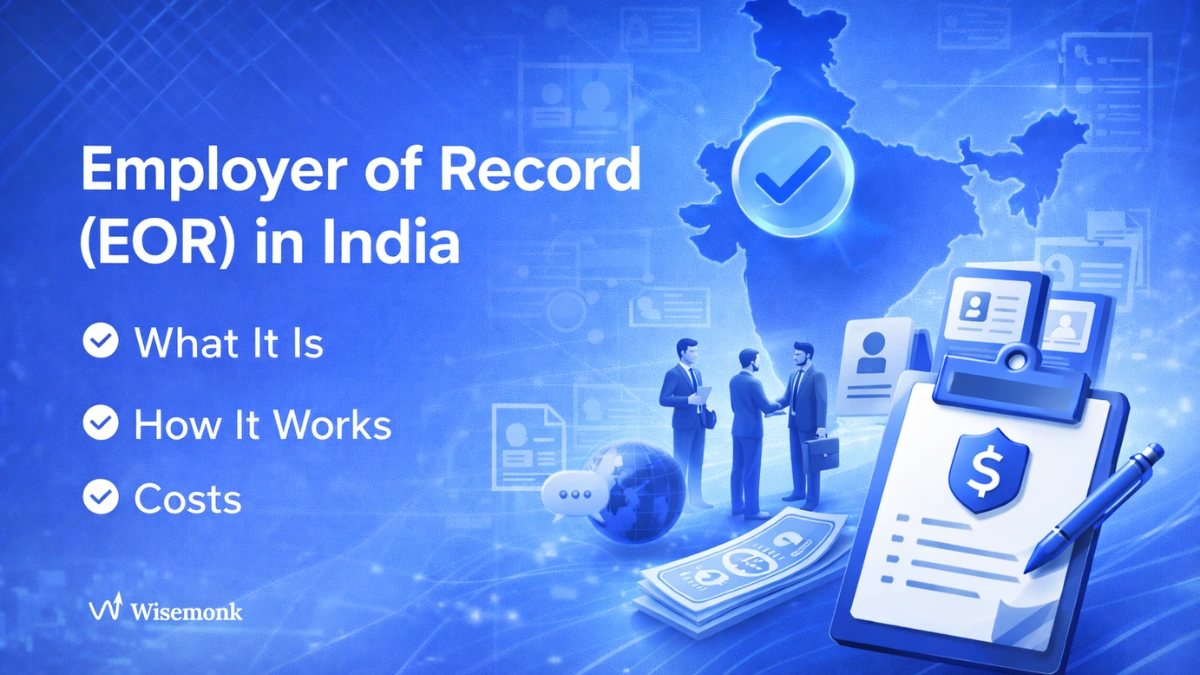
An Employer of Record (EOR) provides a structured way to hire full-time employees in India without setting up a local legal entity. The EOR becomes the legal employer on paper, handling payroll, employment contracts, tax filings, and statutory benefits such as Provident Fund and Employee State Insurance, while you retain operational control.
Need help with Employer of Record in India? Reach out to us today!
Discover how Wisemonk creates impactful and reliable content.
What is an Employer of Record in India?[toc=What is an EOR in India]
An Employer of Record (EOR) in India is a third-party organization that legally employs workers on your behalf. It handles employment contracts, payroll, taxes, and statutory benefits like Employees' Provident Fund and Employee State Insurance.
You keep full control over daily work and performance. The EOR handles legal and administrative compliance, so foreign companies can hire employees in India without setting up a local entity.
Who Is the Legal Employer?
The EOR is the legal employer on paper. Its name goes on the employment contract, and it's responsible for filing payroll taxes, managing social security contributions, and ensuring compliance with local labor laws.
You stay in charge of everything operational: what your employees work on, how they perform, and how your team runs day to day.
It's a clean split. The EOR owns the legal compliance. You own the work. This matters because Indian employment laws place significant obligations on the legal employer, and with an EOR, those responsibilities sit with a registered Indian legal entity, not your company.
Is EOR Legal in India?
Yes. Using an Employer of Record in India is fully legal.
India doesn't have a specific "EOR law," but EOR providers operate within the country's existing legal framework. They are registered Indian companies that employ workers under compliant written employment contracts, governed by laws like the Indian Contract Act and the four Labor Codes.
Because the EOR is itself a local entity, all employment relationships fall under Indian labor laws. This gives foreign employers a compliant path to hire full-time employees without establishing their own legal entity.
For a deeper look at how this structure holds up legally, read our guide on the legal implications of using an Employer of Record in India.
How Does an Employer of Record Work in India?[toc=How EOR Works]
The process is straightforward. You find and select the talent. The EOR handles everything that makes hiring employees in India legally compliant, from employment contracts to monthly payroll and statutory filings.
Here's how it works, step by step:
Onboarding typically takes 2 to 14 days, significantly faster than incorporating a local entity in India.
From what we've seen helping 300+ global companies onboard employees in India, most delays don't come from the EOR process itself but from incomplete document collection on the employee's side. Having a clear checklist ready before the start date keeps things moving smoothly.
That's the operational flow at a high level.
For a detailed walkthrough of each step, read our full guide on how EOR works in India.
What Does an EOR Handle in India?[toc=EOR Responsibilities]
An EOR in India takes on every legal and administrative responsibility tied to employing your team.
Here's what's covered:
From what we've seen helping global companies hire in India, the functions that trip up foreign employers the most are statutory filing deadlines and gratuity tracking. Missing deadlines can result in penalties and interest, which is exactly why most companies prefer an EOR provider that automates these workflows.
For a closer look at how this directly benefits US-based companies, read our guide on the benefits of using an Employer of Record in India for US companies.
Do You Need a Legal Entity to Hire in India?[toc=Legal Entity in India]
No. You don't need to set up a local entity to hire employees in India. An Employer of Record lets you hire full-time employees through its registered Indian entity, skipping the months-long incorporation process entirely.
That said, hiring without the right structure creates real risks.
Here are the three biggest ones foreign companies need to watch for:
- Permanent Establishment (PE) Risk: Hiring directly in India without a legal entity or EOR may create a taxable presence, known as Permanent Establishment, triggering corporate tax obligations in India. An EOR eliminates this risk because employees sit on the EOR's payroll, creating a clean legal separation between your company and Indian tax jurisdiction.
- GST and Tax Exposure: Foreign companies cannot legally run payroll in India without a registered entity. Attempting to pay employees directly from overseas can create GST, TDS, and foreign exchange (FEMA) compliance issues. An EOR absorbs these obligations since all payroll processing and tax filings run through its local entity.
- Compliance Liability: India's labor laws operate across central and state levels. Without a local entity or EOR handling legal compliance, foreign employers face risks around misclassification of workers, missed statutory contributions, and unenforceable employment contracts. These gaps can result in backdated liabilities and penalties.
From what we've seen working with global companies entering India, PE risk and payroll tax exposure are the two areas that catch foreign employers off guard. Companies that plan their employment structure early reduce risk significantly.
If your team grows and you eventually want to set up your own presence, read our guide on how to transition from EOR to a legal entity in India.
Check out our EOR vs. Entity Setup Calculator →
Employer of Record India Pricing (What to Expect)[toc=EOR Pricing]
In India, EOR pricing is typically structured as either a flat monthly fee or a percentage of payroll. Understanding the difference helps you compare providers and budget accurately.
Flat Monthly Fee: The provider charges a fixed amount per employee per month, regardless of salary. This is the most common model among India-focused EOR providers and keeps monthly costs predictable.
Percentage of Salary: Some providers charge a percentage of the employee's gross monthly salary, typically ranging from 5% to 25%. Costs scale with compensation, so they increase as you hire senior roles. A few providers use a hybrid approach, combining a lower flat fee with a small percentage of payroll.
What Impacts Pricing:
Several factors influence what you'll actually pay beyond the base EOR fee:
- Team size: Larger teams often qualify for volume-based discounts.
- Role complexity: Senior or specialized roles may increase administrative complexity.
- Benefits scope: Adding health insurance or custom perks beyond statutory benefits increases overall cost.
- Onboarding and offboarding fees: Some providers charge separately for setup or exit processing.
- Currency conversion: Cross-border payments may carry FX markups that aren't always visible upfront.
From what we've seen helping global companies hire in India, the key is to ask for a full cost breakdown before signing so there are no surprises on your first invoice.
For a detailed breakdown, read our full guide on the cost of EOR in India.
Check out our Employee cost calculator →
EOR vs Direct Hiring in India[toc=EOR vs Direct Hiring]
Both models let you hire employees in India, but they differ significantly in setup time, compliance ownership, and cost structure.
Here's how they compare:
Choosing between an EOR and direct hiring depends on your long-term India strategy. Neither model is inherently better.
Many companies use an EOR during early market entry, then evaluate entity setup as headcount and business needs grow. From what we've seen working with global companies at different stages of India expansion, getting the structure right early saves significant time and compliance risk down the line.
For a detailed side-by-side analysis, read our full comparison of EOR vs. direct hiring in India.
When Should Companies Use an EOR in India?[toc=When to Use EOR]
An EOR isn't the right fit for every situation, but there are specific scenarios where it makes the most sense:
- Testing the Indian Market: You want to explore India as a talent market before committing long-term. An EOR lets you test demand, build a small team, and scale based on results.
- Hiring Your First 1 to 15 Employees: At this team size, entity incorporation rarely makes sense. An EOR gives you compliant payroll, statutory benefits, and employment contracts without local infrastructure overhead.
- Building a Remote Team: You need to hire across multiple Indian cities without a physical office. The EOR handles multi-state compliance, since Indian labor laws vary by state, so you don't have to track local regulations for each location.
- Avoiding Entity Setup: You need full-time employees in India but aren't ready for the time, cost, and administrative burden of setting up a legal entity. An EOR provides a compliant path while you focus on core business activities.
- Short-Term or Project-Based Hiring: You need to scale a team quickly for a defined project and offboard cleanly when it ends. An EOR offers the flexibility to do this without long-term legal commitments.
Many companies begin with a small team of 3 to 5 employees before deciding on long-term entity setup. Getting the employment structure right at this stage makes scaling significantly easier.
For a step-by-step walkthrough, read our guide on how to hire remote employees in India using an EOR.
Best Employer of Record Providers in India[toc=Best EOR in India]
Choosing the right EOR depends on whether you need global multi-country coverage or India-specific expertise.
Here is a brief overview of several widely used EOR providers operating in India:
1. Wisemonk
India-focused EOR platform built for global companies hiring in India. Wisemonk covers payroll, statutory compliance, benefits administration, and employee management with experience navigating Indian labor laws and multi-state requirements. Suitable for companies prioritizing India-specific expertise over multi-country coverage.
Explore Wisemonk's Employer of Record services in India →
2. Deel
Global EOR platform operating in 150+ countries with its own legal entity in India. Known for automated contract generation, fast onboarding, and a unified global dashboard. Suited for companies hiring across multiple countries through a single platform.
3. Rippling
All-in-one HR, IT, and payroll platform with EOR services in India. Combines employer of record capabilities with device management and workforce analytics. A fit for companies looking to unify HR and IT operations under one system.
4. Papaya Global
Enterprise-grade payroll and EOR platform covering 160+ countries with AI-driven compliance tools. Designed for larger organizations managing complex, multi-country payroll operations.
5. RemoFirst
EOR provider covering 180+ countries with a flat-rate pricing model. Handles payroll in INR, statutory compliance, and contractor management. Suited for startups and smaller teams during early India expansion.
When evaluating providers, the key factors to compare are entity ownership in India, multi-state compliance expertise, pricing transparency, onboarding speed, and the level of local HR support available.
Get Started With Wisemonk EOR[toc=Wisemonk EOR]
If you're hiring in India and need a partner that understands Indian labor laws, payroll compliance, and statutory benefits inside out, Wisemonk is built for exactly that.
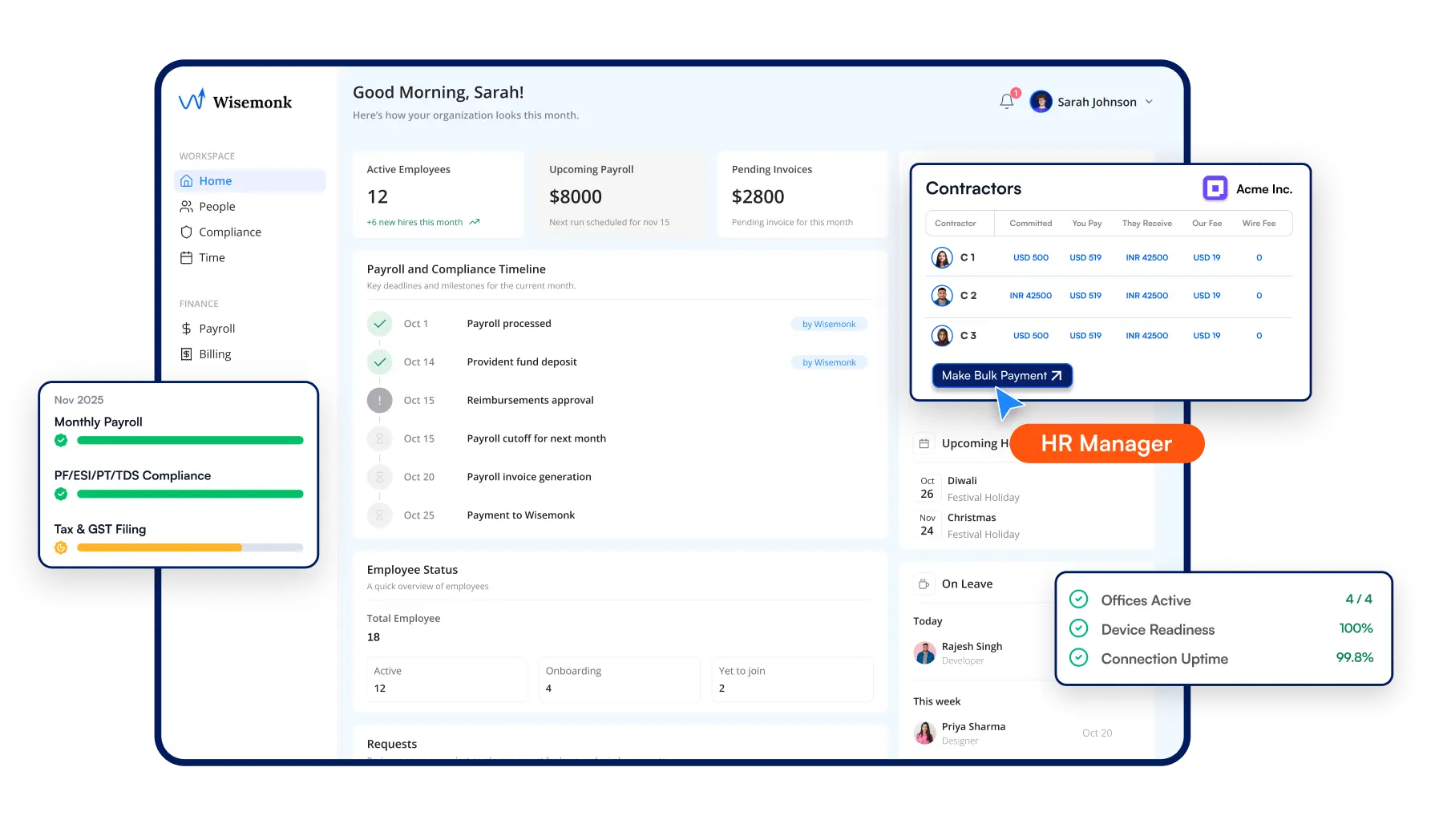
We work with 300+ global companies, manage $20M+ in payroll, and support 2,000+ employees across India. Whether you're hiring your first developer in Bangalore or scaling a 50-person team across multiple states, we handle the entire employment lifecycle so you can focus on your core business activities.
Here's what you get with Wisemonk EOR:
- Fast onboarding: Go from signed offer to fully compliant employee in 2 to 14 days.
- Complete payroll management: Monthly payroll in INR with PF, ESI, TDS, professional tax, and gratuity handled end to end.
- Compliant employment contracts: Drafted under Indian labor laws with IP protection, termination terms, and state-specific clauses.
- Benefits administration: Statutory benefits plus health insurance, meal allowances, and custom perks tailored to your team.
- Dedicated local HR support: On-ground specialists who handle employee queries, leave management, and day-to-day HR operations.
- Transparent pricing: Starting at $99 per employee per month. No hidden fees. No FX markups.
Every month, you receive one consolidated invoice. No surprises.
Whether you're a Series A startup building your first India team or an established company expanding headcount, Wisemonk gives you the compliance, speed, and local expertise to hire in India with confidence.
Talk to our India hiring experts today →
Frequently asked questions
Is EOR legal in India?
Yes. There is no specific EOR law in India, but EOR providers operate as registered Indian companies that employ workers under existing labor laws. All employment contracts, payroll, and statutory filings are governed by Indian legal frameworks, making it a fully compliant hiring model.
How long does onboarding take through an EOR?
Most EOR providers like Wisemonk can onboard an employee in 2 to 14 days. This includes background checks, document collection, PF and ESI registration, contract signing, and payroll setup. Delays typically happen when employee documents are incomplete.
Can employees transition from EOR to my own entity later?
Yes. Many companies start with an EOR and transition employees to their own legal entity once headcount justifies it. A good EOR maintains clean employment records, payroll history, and compliance documentation, which makes the migration smoother.
Does an EOR manage employee benefits in India?
Yes. An EOR handles all statutory benefits, including Employees' Provident Fund, Employee State Insurance, gratuity, paid leave, and maternity leave for female employees. Most providers also support supplementary benefits like health insurance and meal allowances.
What taxes are included in EOR payroll?
EOR payroll in India covers TDS (income tax withholding), Employees' Provident Fund contributions, Employee State Insurance, professional tax (state-specific), and gratuity tracking. The EOR files all returns with the relevant government authorities on your behalf.
What is the difference between an EOR and a PEO in India?
A PEO operates under a co-employment model, which requires you to already have a legal entity in India. An EOR acts as the sole legal employer, so you can hire without an entity. In India, the traditional PEO co-employment structure is not recognized, making EOR the compliant option for foreign companies without a local presence.
Can an EOR help with hiring independent contractors in India?
Some EOR providers also offer contractor management services. However, the key value of an EOR is hiring full-time employees compliantly. If a role looks like full-time employment, using an EOR to hire the worker as an employee reduces the risk of misclassification and the legal disputes that come with it.





.webp)
.webp)

.webp)
.webp)
.webp)

.webp)
.webp)
.webp)
.webp)

.webp)

.webp)

.webp)

.webp)
.webp)

.webp)
.webp)
.webp)

.webp)

.webp)
.webp)
%20Explained.webp)
.webp)


%20(1).webp)
.webp)
%20in%20India%20(2024).webp)

.webp)
.webp)
.webp)

%20(1).webp)



%201.webp)


%20in%20India.webp)
%20(1).webp)

.webp)

.webp)
.webp)
.webp)