An Employer of Record (EOR) in India allows foreign companies to hire local talent quickly, often in days, without needing to establish a local entity. This bypasses complex regulations.
The advantages include complete legal compliance with labor laws, payroll, and taxes, as well as reduced administrative burdens and faster market entry.
However, the disadvantages involve higher long-term costs for larger teams, less direct control over human resources, and a potential dependence on the EOR for operational stability.
Need help with Employer of Record in India? Reach out to us today!
Discover how Wisemonk creates impactful and reliable content.
What are the pros & cons of an EOR in India?[toc=Pros & Cons of EOR in India]
From what we have seen helping 300+ global companies hire in India, an Employer of Record (EOR) is one of the fastest ways for foreign businesses to onboard employees without setting up a legal entity. But it is not a perfect fit for everyone.
Here is an honest breakdown based on what we have actually observed working with US, UK, and European startups expanding into India:
Pros of Using an Employer of Record in India
1. Skip the legal entity setup entirely
Registering your own legal entity in India involves the Ministry of Corporate Affairs, GST, TAN, and EPFO registration. That takes 3 to 6 months and $15,000 to $50,000 upfront.
An EOR already has an established local entity, so you can start hiring employees within 24 to 48 hours. For Series A startups under pressure to ship faster, this time savings alone is a dealbreaker.
2. Comprehensive compliance with Indian labor laws
India enacted its biggest labor law overhaul in decades. As of November 2025, 29 central labor laws were consolidated into four new Labor Codes, with final central rules expected by April 2026. Compliance requirements are actively changing.
A reliable EOR partner handles Provident Fund (12% of basic salary), Employee State Insurance, TDS under the Income Tax Act, professional tax, gratuity, and the new 50% wage structuring rule. Penalties for non-compliance now range from INR 50,000 to INR 100,000 per violation.
We have seen companies get caught off guard by state-level variations alone, which is why local compliance expertise matters so much.
3. End-to-end payroll and tax management
Indian payroll processing involves monthly TDS filings with the Income Tax Department, PF and ESI remittances, quarterly returns, and state-specific professional tax calculations.
An EOR takes over this entire administrative burden, freeing up your HR and finance teams.
4. Statutory benefits and employee benefits handled for you
Indian employees are legally entitled to Provident Fund, ESI, gratuity (now payable after 1 year for fixed-term employees under the new codes), maternity leave, and annual bonuses.
A good EOR handles all benefits administration, including optional perks like health insurance, which directly impacts employee satisfaction and retention.
5. Reduced compliance and legal risks
Misclassifying workers, missing filings, or drafting non-compliant employment contracts can expose you to permanent establishment risk and IP ownership disputes. The EOR acts as the legal employer, absorbing liability for compliance and risk management.
This is one of the most underrated advantages we see startups overlook until something goes wrong.
6. Real cost savings
Senior developers in India cost roughly 60-70% less than their US counterparts. When you add the savings from skipping entity setup, local HR hires, and compliance infrastructure, the cost efficiency is significant for startups watching their burn rate.
7. Simplified global workforce management
For remote-first companies, an EOR centralizes payroll management, compliance monitoring, automated contract generation, and often provides dedicated account managers who understand local regulations.
This beats coordinating between separate law firms, payroll vendors, and benefits brokers.
Read more: Benefits of Using an Employer of Record (EOR) in India.
Cons of Using an Employer of Record in India
1. Less direct control over HR processes
The EOR is the legal employer, so formal employment decisions like terminations and contract changes go through them first. You keep day-to-day operational control, but you do not have full autonomy over HR actions.
2. Watch out for hidden costs
Beyond the monthly per-employee fee ($99 to $599/month depending on the provider), some EOR services charge setup fees, security deposits (often one month's salary), currency exchange markups (2-10%), and offboarding charges.
From our experience, always audit the full pricing structure before signing.
3. Your compliance is only as good as your EOR
If your EOR partner lacks deep local legal expertise, especially around state-level rules and the new Labor Codes, problems may surface only during audits or disputes. Your team also does not build internal knowledge of Indian employment law since it is fully outsourced.
4. Limited customization
Most EOR providers use standardized employment contracts and benefits packages. If you need custom equity structures, non-standard compensation models, or unique benefits for engineering talent, some providers can be rigid.
5. Cultural integration takes extra effort
Your Indian employees are technically employed by a third-party service provider. Building real company culture and belonging requires intentional effort from your side, especially for long-term engineering teams.
6. Not the best fit at large scale
If you are planning to hire 50+ employees in India as a permanent base, the per-employee EOR cost starts adding up. At that scale, setting up your own legal entity often makes more financial sense.
EOR works best for teams of 1 to 30, or as a bridge while you test the market.
You must also check out our articles on the Cost of EOR in India & Best EOR Service Providers in India.
Get Started With Wisemonk EOR[toc=Choose Wisemonk EOR]
If you are a growing startup or a global company looking to hire employees in India without the hassle of setting up your own legal entity, Wisemonk is built exactly for that.
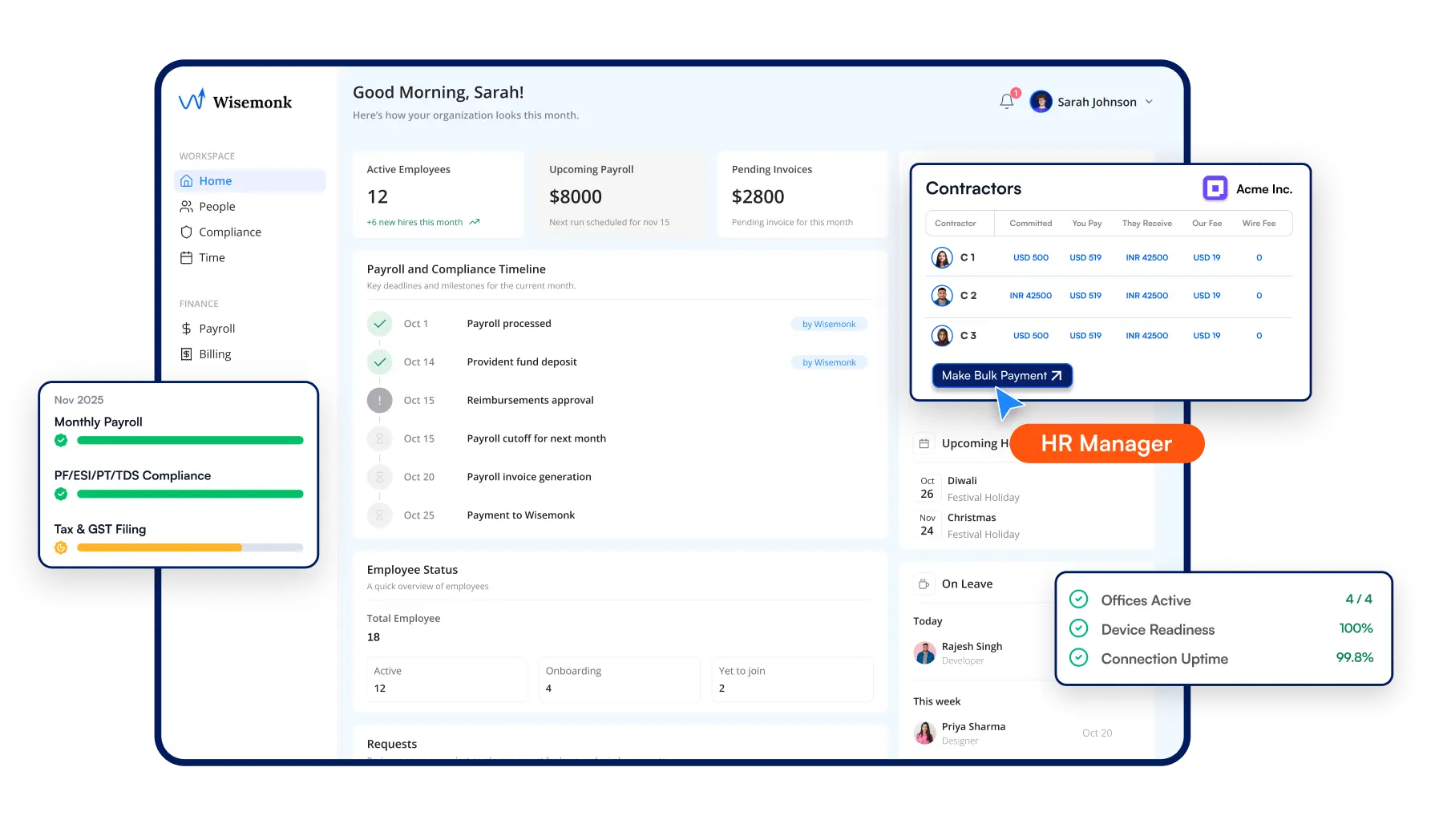
We are not a global EOR trying to cover 150 countries with a thin layer of support everywhere. Wisemonk is India-focused, and that is our edge.
We manage 2,000+ employees for 300+ foreign companies with $20M+ in payroll under management.
We know Indian labor laws, the new Labor Codes, state-level compliance, and the real operational challenges that come with hiring in India because we deal with them every single day.
Here is what you get with Wisemonk EOR:
- 24-48 hour onboarding so you never lose a candidate to slow processes
- Comprehensive compliance with PF, ESI, TDS, professional tax, gratuity, and the new Labor Code requirements
- Transparent pricing starting at $99/month per employee with no hidden costs or surprise fees
- Automated contract generation with locally compliant employment contracts
- End-to-end payroll processing in INR, including all statutory filings with the Income Tax Department
- Dedicated account managers who understand your business, not a generic support ticket system
- Full benefits administration covering statutory benefits, health insurance, and expense management
- Compliance monitoring and tools that keep you ahead of regulatory changes, not reacting to them
Whether you are hiring your first engineer in India or scaling an entire remote engineering team, Wisemonk handles the compliance, payroll, and HR so you can focus on building your product.
Talk to our EOR experts today and onboard your first Indian employee this week →
Frequently asked questions
Is using an Employer of Record legal in India?
Yes, EOR services are fully legal in India. The EOR operates as a registered legal entity under Indian law and acts as the legal employer for your workers, handling employment contracts, payroll taxes, and statutory contributions in compliance with local employment laws.
What is the difference between an EOR and a PEO in India?
With a PEO (Professional Employer Organization), you still need your own legal entity in India since it is a co-employment model. An EOR requires no local entity at all. The EOR becomes the legal employer on record, taking full responsibility for compliance, payroll, and statutory benefits on your behalf.
Can an EOR help with employee termination in India?
Yes. India has strict termination laws, including mandatory notice periods (typically 1 to 3 months) and severance requirements. Your EOR handles compliant offboarding, ensuring proper notice, final settlements, gratuity payouts, and documentation in line with Indian employment law.
Does using an EOR in India create permanent establishment risk?
When structured correctly, an EOR arrangement does not create permanent establishment risk for foreign companies. Since the EOR is the legal employer and the local entity, your company does not have a taxable presence in India. However, choosing the right EOR partner with local tax expertise is critical to ensure compliance with Income Tax Act provisions.
How does an EOR handle India's state-level compliance differences?
Indian labor laws vary significantly across states, from professional tax rates to Shops and Establishments Act rules and local labor welfare fund requirements. A good EOR maintains multi-state compliance capabilities and updates employment contracts, payroll processing, and statutory filings based on where each employee is located.
Can I convert EOR employees to my own entity later?
Yes, most EOR providers support transitioning employees to your own legal entity when you are ready. This involves drafting new employment contracts, transferring benefits like Provident Fund accounts, and ensuring continuity of service. Clarify this transition process and any associated fees with your EOR partner before signing.
What mandatory statutory benefits must an EOR provide to Indian employees?
At minimum, an EOR must provide Employees' Provident Fund (12% employer contribution), Employee State Insurance (for employees earning up to INR 21,000/month), gratuity, paid leave and public holidays as per state laws, maternity benefits (26 weeks for eligible women), and annual bonuses under the Payment of Bonus Act.
.webp)







.png)















.webp)
.webp)

.webp)
.webp)

.webp)
.webp)





.webp)
.webp)
.webp)





.webp)

.webp)


.webp)



.webp)

%20in%20India.webp)




.webp)