An Employer of Record (EOR) in India serves as the legal employer for foreign companies, enabling them to hire local staff without needing to set up a subsidiary.
The EOR takes on complete responsibility for adhering to Indian labor laws, managing payroll in INR, handling tax withholding (TDS), and providing statutory benefits such as Provident Fund (PF) and Employees' State Insurance (ESI). Meanwhile, the client company oversees the daily tasks of the employees.
Need help with Employer of Record in India? Reach out to us today!
Discover how Wisemonk creates impactful and reliable content.
How does an EOR work in India?[toc=How EOR Works in India]
An Employer of Record (EOR) in India is a third-party organization that becomes the legal employer for your team in India. You find the talent, manage them day-to-day, and make all the work decisions.
The EOR handles everything on the legal and compliance side, including drafting employment contracts, running payroll, filing payroll taxes, and managing statutory benefits like Employees Provident Fund (EPF) and Employee State Insurance (ESI).
No local entity needed. No months of paperwork. You can go from selecting a candidate to having them fully onboarded in as little as 7 to 14 business days.
Let's break down exactly how an employer of record works in India, step by step:
Step 1: You Find and Select Your Candidate
This part doesn't change. You define the role, source candidates however you normally would (LinkedIn, referrals, job boards), run your interviews, and pick the person you want to hire.
Some EOR providers like Wisemonk can help with candidate sourcing, but the hiring decision is always yours.
Step 2: Share Role Details with Your EOR Provider
Once you've picked your candidate, you share the offer details with the EOR: job title, responsibilities, expected salary (basic salary + allowances), preferred start date, and any specific employee benefits you want to offer like health insurance or stock options.
The EOR uses this to build out the compliant employment contract.
Step 3: The EOR Drafts a Compliant Employment Contract
This is where things get critical. Indian labor laws require a written employment contract that covers specific elements: job role, compensation breakdown, probation period, notice period, leave entitlements, termination terms, confidentiality clauses, and IP assignment.
The EOR drafts this in line with the Indian Contract Act and applicable state-level Shops and Establishments Acts, so the employment agreement holds up legally. This protects both you and your employee.
Step 4: Background Verification and Document Collection
The EOR conducts background checks (employment history, education verification, professional references) and collects all legally required documents from the new hire. This includes their PAN card (for income tax), Aadhaar card (national ID), bank account details for salary payments, and address proof.
These documents are essential for enrolling employees in statutory benefits like the Employees Provident Fund and Employee State Insurance.
For international workers who need an employment visa, the EOR's local entity can sponsor the visa application and handle registration with the Foreigners Regional Registration Office (FRRO) if the stay exceeds 180 days.
Step 5: Employee Registration with Statutory Authorities
The EOR registers your employee with all relevant statutory authorities. This includes:
- Employees Provident Fund (EPF): A mandatory retirement benefits scheme where both employer (12% of basic salary) and employee contribute.
- Employee State Insurance (ESI): Health insurance coverage for employees earning below a specified threshold (employer contributes 3.25%, employee contributes 0.75%).
- Professional Tax: A state-level tax that varies by location.
- Tax Deduction Account Number (TAN): Required for deducting and remitting income tax (TDS) from employee salaries under the Income Tax Act.
All of this is handled without you needing to understand the specifics of local employment regulations in each Indian state.
Step 6: Monthly Payroll Processing and Tax Filing
Every month, the EOR calculates your employee's salary, applies all statutory deductions (income tax via TDS, EPF contributions, ESI contributions, professional tax), and processes payroll in Indian Rupees (INR). They also handle filing payroll taxes with the government on time, issuing payslips, and making sure social security contributions reach the right authorities.
The EOR takes care of the entire payroll system, so you see one consolidated invoice on your side. No dealing with complex labor laws or tax regulations yourself.
Step 7: Ongoing Benefits Administration and Compliance
Beyond payroll, the EOR manages statutory benefits like health insurance, gratuity (applicable after 5 years of service), leave tracking (earned leave, sick leave, national holidays), and any additional employee benefits you choose to offer.
They also ensure compliance with the various labor laws that apply to your employees in India, including the Industrial Disputes Act, Payment of Bonus Act, Maternity Benefit Act, and the Labour Welfare Fund.
If Indian employment regulations change (and they do, since compliance rules vary by state), the EOR keeps you updated and adjusts accordingly. You stay focused on your product and team; they handle legal compliance.
Step 8: Offboarding and Termination (When Needed)
When an employee leaves or needs to be let go, the EOR manages the full exit process: calculating the final settlement (including severance pay if applicable), processing gratuity payments, serving proper notice periods as required by the employment contract, and issuing relieving and experience letters.
For employees classified as "workmen" under Indian law, there are specific severance requirements (15 days' average pay per year of service for retrenchment).
This is where many foreign companies run into trouble without an EOR because India's termination laws are strict, and getting it wrong can lead to legal disputes.
From what we've seen at Wisemonk helping global companies hire in India through an EOR, most teams go from zero to a fully onboarded employee in under two weeks. Compare that to 3 to 6 months for setting up a local entity, and the cost savings and speed become pretty clear.
You must also check out our articles on the Cost of EOR in India & Best EOR Service Providers in India.
What are the key compliance responsibilities?[toc=Key Compliance Responsibilities]
When you use an employer of record in India, the EOR becomes the legal employer and handles all compliance.
Here's what that covers:
- Employment Contracts: Indian labor laws require a written employment contract covering salary, probation (3 to 6 months), notice period, leave, termination terms, and IP assignment. Must comply with the Indian Contract Act and state-specific Shops and Establishments Acts.
- Income Tax (TDS): The EOR withholds Tax Deducted at Source from every employee's salary monthly under the Income Tax Act and remits it via a registered Tax Deduction Account Number (TAN). Late filing triggers penalties starting at INR 200/day.
- Employees Provident Fund (EPF): Mandatory retirement benefit. Both employer and employee contribute 12% of basic salary. This also covers the Employees Pension Scheme (EPS), carved from the employer's share.
- Employee State Insurance (ESI): Health insurance for employees below a salary threshold. Employer pays 3.25%, employee pays 0.75%. The EOR handles registration and monthly filings.
- Gratuity: Any employee completing 5+ years of service is entitled to a gratuity payout under the Payment of Gratuity Act. The EOR tracks eligibility and processes payments during offboarding.
- Minimum Wage: Varies by state, skill level, and industry. The EOR ensures employee compensation stays compliant with local regulations.
- Leave and Working Hours: Employees get 15 to 20 days earned leave, 7 to 12 days casual leave, ~12 days sick leave, plus national holidays. Standard workweek is 48 hours (max 9 hours/day). Overtime must be paid.
- Professional Tax and Labour Welfare Fund: Both are state-level statutory deductions. Amounts vary by location. The EOR calculates and deducts these automatically.
- Termination: Strict rules. Notice periods of 30 to 90 days, severance pay of 15 days' pay per year of service for retrenchment, and special protections for employees on maternity leave. The EOR manages final settlements, gratuity, and relieving letters.
- New Labour Codes (2026 Update): India has consolidated 29 older laws into four new codes (Wages, Industrial Relations, Social Security, Occupational Safety). Full enforcement is rolling out state by state. A good EOR stays ahead of these changes so you don't have to.
India's compliance spans several labor laws, tax regulations, and state-level variations. An employer of record ensures compliance across all of them, so you can focus on building your team instead of decoding local employment regulations.
Get Started With Wisemonk EOR[toc=Choose Wisemonk EOR]
If you're a global company looking to hire employees in India without setting up a local entity, Wisemonk makes it simple.
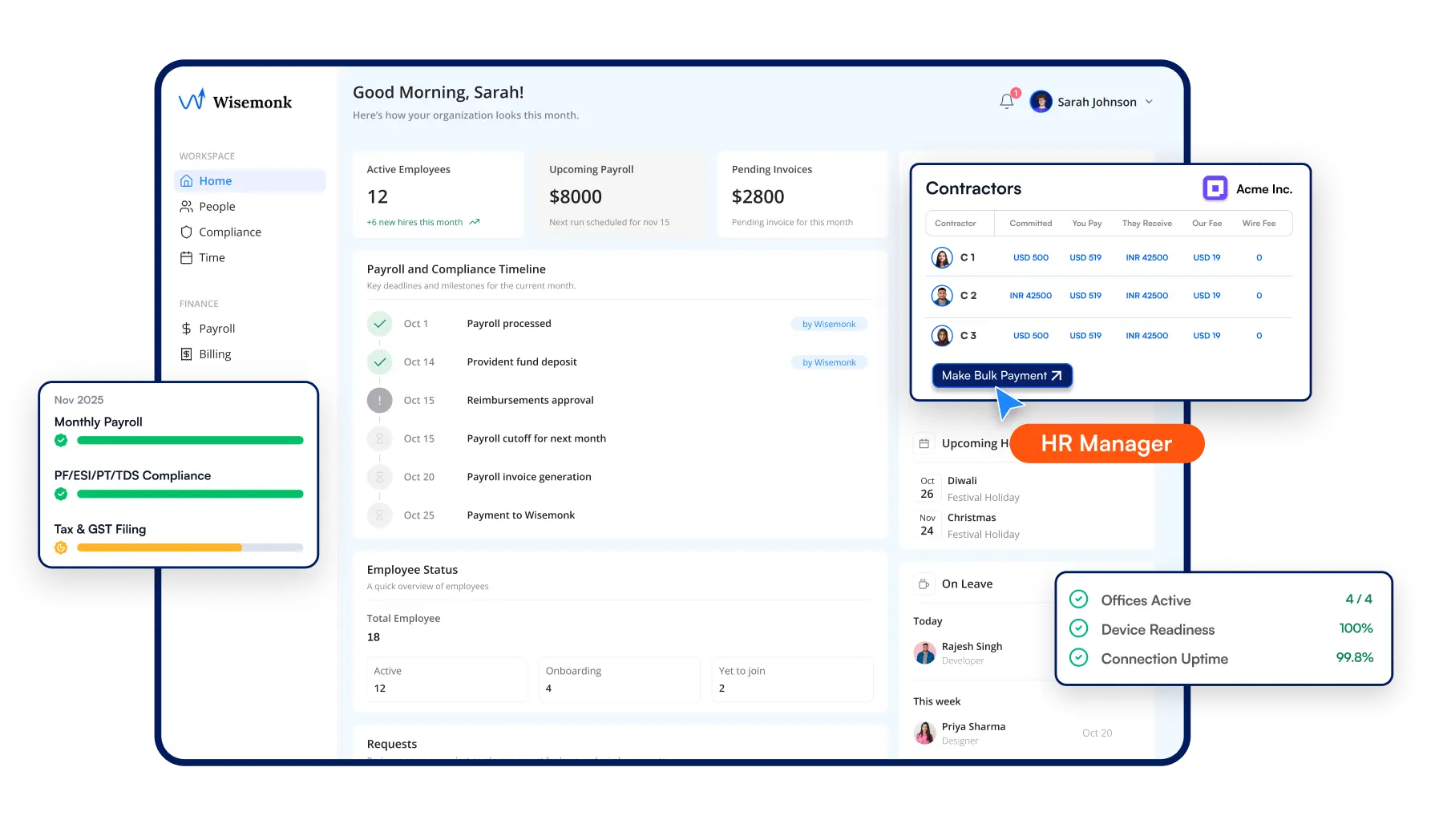
We've helped 300+ foreign companies onboard and manage 2,000+ employees across India, handling everything from drafting employment contracts and filing payroll taxes to managing statutory benefits like EPF, ESI, and gratuity.
Here's what you get with Wisemonk EOR:
- Onboarding in 7 to 14 days: No entity setup, no months of paperwork. We act as the legal employer, so your new hire can start fast.
- Full compliance with Indian labor laws: Employment contracts, TDS, provident fund, employee state insurance, minimum wage, gratuity, and every state-level regulation handled end to end.
- Payroll processed in INR, every month, on time: Statutory deductions, tax filings, payslips, and expense management taken care of. You get one consolidated invoice.
- Employee benefits that attract top talent: Health insurance, retirement benefits, leave management, and bonus act compliance. Your employees in India get the same experience as any locally hired team member.
- Transparent pricing, no hidden fees: Starting at $99 per employee/month, no percentage-based markups. No surprise charges when you hire senior engineers over junior ones.
- India-first expertise: We're not a global platform that treats India as one of 150 countries. India is all we do, and we know the complex labor laws, tax regulations, and local employment regulations inside out.
Whether you're hiring your first developer in Bangalore or scaling a full engineering team across India, Wisemonk gives you the speed, compliance, and cost savings to do it right.
Talk to our EOR experts today and get your first employee onboarded within two weeks!
Frequently asked questions
What's the difference between an EOR and a PEO in India?
A PEO (Professional Employer Organization) is a co-employment model where you still need a legal entity in India. An EOR requires no entity at all. The EOR becomes the legal employer on record and takes full liability for payroll, taxes, and compliance.
Does using an EOR in India create permanent establishment (PE) risk?
No. Since the EOR is the legal employer and your company has no registered entity in India, using an employer of record typically does not trigger permanent establishment risk under Indian tax laws. The EOR structure keeps your business separate from Indian tax jurisdiction.
Who owns the intellectual property (IP) created by employees hired through an EOR?
You do. The EOR includes strong IP assignment and confidentiality clauses in every employment contract, ensuring all work product, code, designs, and inventions created by the employee legally belong to your company.
Can I convert my existing independent contractors in India to full-time employees through an EOR?
Yes. This is actually one of the most common use cases. An EOR can convert contract workers to full-time employees, eliminating misclassification risk and ensuring compliance with Indian labor laws from day one.
How much does it typically cost to use an EOR in India?
EOR pricing usually includes two components: the employee's gross salary (including statutory contributions like EPF, ESI, and gratuity) plus a flat monthly service fee. Most India-focused EOR providers charge between $99 to $299 per employee per month, depending on the scope of services.
Can an EOR hire employees across multiple Indian states?
Yes. India's compliance rules vary by state, and each state has its own Shops and Establishments Act, professional tax rates, and local regulations. A good EOR manages multi-state registrations and compliance so you can hire in Bangalore, Mumbai, Delhi, or any other city without separate setups.
What happens if I eventually want to set up my own entity in India?
Many companies start with an EOR and transition to a local entity once they scale. A well-organized EOR engagement keeps clean employment records, compliant payroll history, and proper documentation, making the transition smoother when you're ready.
.webp)






.png)










.webp)
.webp)

.webp)
.webp)
.webp)
.webp)




.webp)
.webp)
.webp)




.webp)
.webp)

.webp)



.webp)

%20in%20India.webp)




.webp)