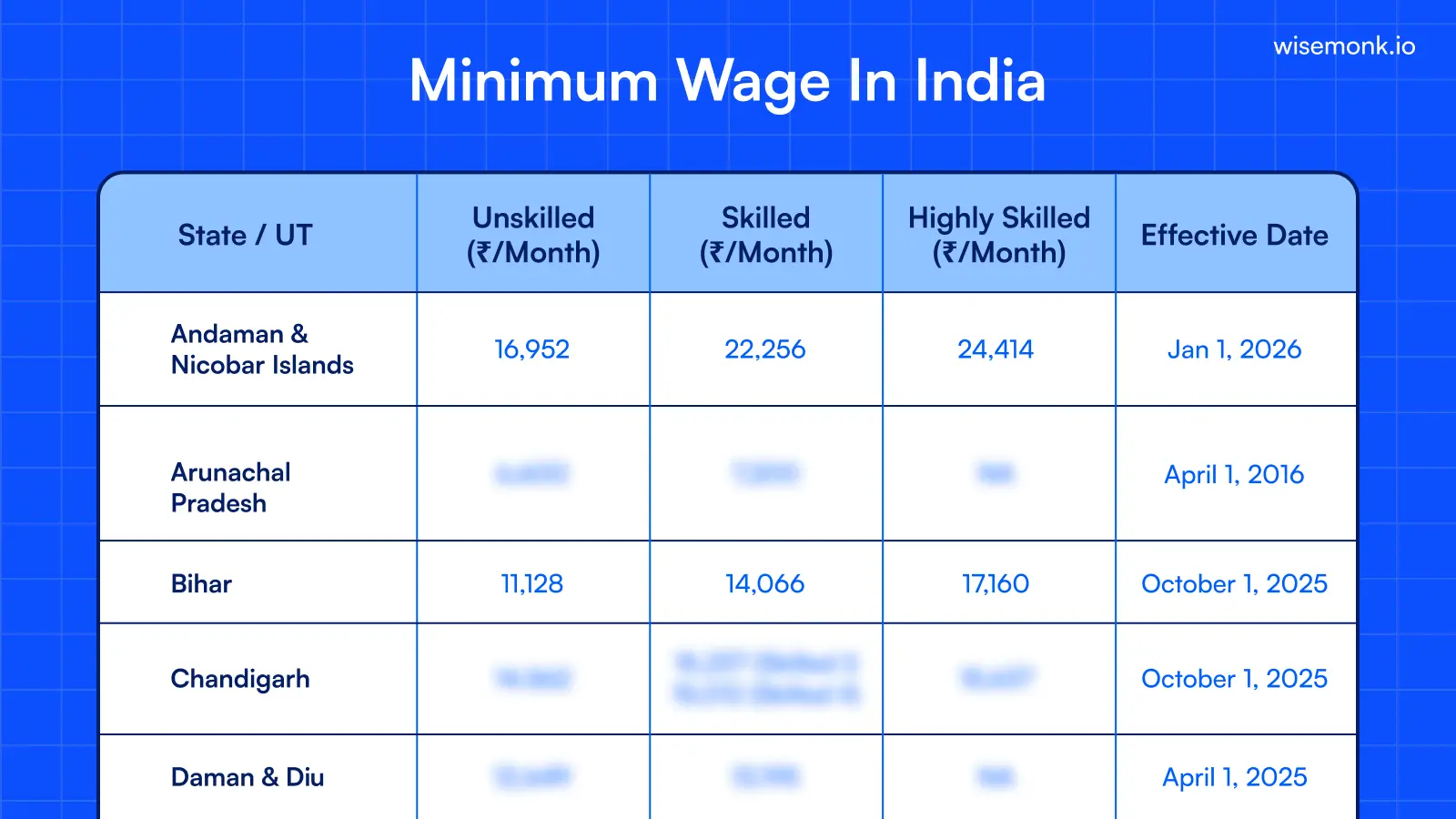
- Indien hat keinen einzigen nationalen Mindestlohn. Die Tarife variieren erheblich je nach Bundesland, Qualifikationsniveau (ungelernt, angelernt, qualifiziert, hochqualifiziert), Branche und Faktoren wie der städtischen/ländlichen Lage und branchenspezifischen Bedingungen.
- Die Zentralregierung legt einen nationalen Mindestlohn von 178$ pro Tag (2,13$) fest, um sicherzustellen, dass die Staaten diesen Basislohn nicht unterschreiten können, und ermöglicht ihnen gleichzeitig, höhere Löhne auf der Grundlage der lokalen wirtschaftlichen Bedingungen und Lebenshaltungskosten festzulegen.
- Staaten wie Delhi, Maharashtra und Karnataka legten höhere Löhne fest, um den lokalen Kosten Rechnung zu tragen. Zum Beispiel in Delhi: Ungelernte 18.456€ pro Monat (205,07$), Qualifizierte 22.411 €/Monat (249,01$), deutlich über dem landesweiten Mindestlohn.
- Der Mindestlohn in Indien wird anhand eines Grundlohns zuzüglich der variablen Dearness Allowance (VDA) berechnet, abhängig von der Klassifizierung der Arbeitnehmer, der Region und der Branche. Die Nichteinhaltung dieser Vorschriften kann zu Geldstrafen und Haftstrafen führen.
Benötigen Sie Hilfe beim Umgang mit den indischen Mindestlohn- und Compliance-Regeln? Setzen Sie sich noch heute mit unseren Experten in Verbindung.
Entdecke wie Wisemonk wirkungsvolle und zuverlässige Inhalte erstellt.
Die Festlegung der Mindestlöhne in Indien kann verwirrend sein, da es in den einzelnen Bundesstaaten und Branchen zu häufigen Änderungen und regionalen Unterschieden kommt, die von der geografischen Lage der einzelnen Bundesstaaten und den lokalen wirtschaftlichen Bedingungen beeinflusst werden. Viele Arbeitgeber sorgen sich um die Einhaltung der Vorschriften, und Arbeitnehmer sind sich oft nicht sicher, ob sie eine faire Bezahlung erhalten.
In diesem Artikel erläutern wir die neuesten Mindestlohnsätze, wie sie festgelegt sind und was Sie für 2026 wissen müssen. Egal, ob Sie Arbeitgeber oder Arbeitnehmer sind, hier finden Sie praktische, aktuelle Antworten.
Aktualisierung vom März 2026:
Der Mindestlohn liegt bei 178€ pro Tag (nicht gesetzlich vorgeschriebener Basiswert, nicht im Amtsblatt bekannt gegeben)
Der Lohnkodex von 2019 trat am 21. November 2025 in vollem Umfang in Kraft. Er ersetzte den Mindestlohngesetz von 1948 und weitete den Geltungsbereich auf alle Arbeitnehmer aus.
Die 50-%-Regel ist jetzt durchsetzbar: Basic Pay + DA muss ≥ 50% des gesamten CTC ausmachen
Frist für die Gehaltszahlung: Die Löhne müssen bis zum 7. eines jeden Monats veröffentlicht werden
Befristet Beschäftigte haben bereits nach einem Jahr Anspruch auf Zuschuss (vorher 5 Jahre)
Eine vorgeschlagene Lohnerhöhung um das 2,5-fache für ausgewählte Kategorien wird derzeit auf Landesebene überprüft
Was ist der Mindestlohn in Indien? [TOC = Mindestlohn in Indien]
Der Mindestlohn in Indien ist der gesetzlich vorgeschriebene niedrigste Lohnbetrag, den Arbeitgeber den Arbeitnehmern für ihre Arbeit zahlen müssen, um eine faire Vergütung für ihre Arbeit zu gewährleisten. Dieser Lohn soll die Arbeitnehmer vor Ausbeutung schützen und sicherstellen, dass sie ihre Grundbedürfnisse decken und einen angemessenen Lebensstandard genießen können.
Das Konzept der Mindestlöhne in Indien begann mit dem Mindestlohngesetz von 1948Dies ist ein wichtiger Schritt in den Bemühungen des Landes, die Arbeitnehmerrechte zu schützen, insbesondere in unorganisierten Sektoren wie der Textilindustrie und der Landwirtschaft, mit dem Ziel, eine faire Bezahlung zu gewährleisten und die Arbeitsbedingungen zu verbessern.
Schlüsselfaktoren, die den indischen Mindestlohn beeinflussen:
Basierend auf unseren umfangreichen Recherchen und jüngsten Regierungsmitteilungen sind hier die wichtigsten Faktoren aufgeführt, die die Mindestlohnsätze in Indien beeinflussen, wie von der Lohngesetzbuch, 2019:
- Variation auf Bundesstaatsebene: Jeder Staat legt seine eigenen Steuersätze auf der Grundlage der lokalen wirtschaftlichen Bedingungen fest.
- Skill-Kategorie: Die Bezahlung variiert je nachdem, ob es sich um ungelernte, angelernte, qualifizierte oder hochqualifizierte Arbeitnehmer handelt.
- Branche/Art der Beschäftigung: In bestimmten Sektoren (z. B. Baugewerbe, verarbeitendes Gewerbe, Landwirtschaft) können unterschiedliche Lohnsätze gelten.
- Standort: Städtische und ländliche Gebiete haben aufgrund der unterschiedlichen Lebenshaltungskosten oft unterschiedliche Lohnstrukturen.
Als Referenz: Ein hilfreicher Konversions-Benchmark ist ungefähr 90€ = 1 USD.
Was ist der aktuelle Mindestlohn in Indien? [TOC = Aktueller Mindestlohn]
Basierend auf unseren umfangreichen Untersuchungen und jüngsten staatlichen Mitteilungen spiegelt der Mindestlohn in Indien für 2026 weiterhin erhebliche regionale und kompetenzbasierte Unterschiede wider.
- Nationaler Mindestlohn: Der nationale Mindestlohn (NFLMW) wird regelmäßig vom Ministerium für Arbeit und Beschäftigung überarbeitet. Der NFLMW liegt derzeit bei ₹178 pro Tag (~$2.13) oder 5.340€ pro Monat (~64 $). Diese Rate wurde 2019 vom Arbeitsministerium angekündigt und seitdem nicht mehr offiziell überarbeitet. Es handelt sich um einen nicht gesetzlich vorgeschriebenen Referenzwert, die Staaten dürfen ihn nicht unterschreiten, sind aber nicht durch eine Mitteilung im Amtsblatt an ihn gebunden. [Quelle]
- Lohnspannen: Laut einem Pressemitteilung zu PIB Delhi, das Der niedrigste Mindestlohn beträgt 783€ (8,7$) pro Tag für ungelernte Arbeiter, während die Der höchste Mindestlohn erreicht 1.035$ (11,5$) pro Tag für hochqualifizierte Arbeitskräfte, wie von der Zentralregierung festgelegt.
Die Mindestlohnuntergrenzen bilden die Grundlage für Mindestlohnstandards und stellen sicher, dass alle Arbeitnehmer einen Lohn erhalten, der den grundlegenden Lebensstandards entspricht. Nachfolgend finden Sie die aktuellen Mindestlohnlisten der Zentralregierung:
- Ungelernte Arbeiter: 20.358€ pro Monat (~226,20 $)
- Angelernte Arbeiter: 22.568€ pro Monat (~250.75 $)
- Facharbeiter: 24.804€ pro Monat (~275.60 $)
- Hochqualifizierte Arbeitskräfte: 26.910€ pro Monat (~299.00 $)
Die einzelnen Staaten haben zwar die Flexibilität, höhere Löhne festzulegen, um ihren wirtschaftlichen Bedingungen und Lebenshaltungskosten Rechnung zu tragen, aber sie können die Löhne nicht unter dem nationalen Mindestlohn festsetzen.
Dieses System trägt dazu bei, Fairness zu wahren und die Unterschiede zu verringern, die durch unterschiedliche Mindestlohnsätze in den einzelnen Regionen verursacht werden, und stellt sicher, dass kein Bundesstaat unter die Grundstandards der indischen Regierung fällt.
Was sind die neuesten landesweiten Mindestlohnsätze im Jahr 2026? [TOC = Landesweiter Mindestlohn]
Wenn Sie zwei Mitarbeiter mit derselben Berufsbezeichnung in zwei verschiedenen indischen Bundesstaaten vermitteln, können sich deren Mindestlöhne um mehr als 40% unterscheiden. Das ist kein Fehler, so ist das indische Lohnsystem konzipiert.
Durch eingehende Recherchen zu bundesstaatlichen Mindestlöhnen und offiziellen staatlichen Mitteilungen haben wir die Mindestlohndaten gemäß dem Shops and Establishment Act für ausgewählte Bundesstaaten Indiens zusammengestellt.
Quelle: Einfachheit
Hinweis: Dies ist keine umfassende Liste aller Mindestlöhne aller Arbeitnehmer, sondern eine kuratierte Sammlung, die auf offiziellen Quellen basiert. Bitte beachten Sie, dass einige Staaten ihre Mindestlohnsätze ungefähr alle sechs Monate ändern. Daher ist es für Arbeitgeber und ausländische Unternehmen ratsam, die neuesten offiziellen staatlichen Mitteilungen zu Rate zu ziehen, um die genauesten und aktuellsten Daten zu erhalten.
Außerdem haben einige Staaten keine neuen Benachrichtigungen herausgegeben. Die angegebenen Zahlen spiegeln die letzten verfügbaren offiziellen Daten wider.
Ist der Mindestlohn in Indien das, was Sie tatsächlich zahlen werden? [TOC = Was Sie tatsächlich zahlen]
Zur Einhaltung der Vorschriften müssen Sie den staatlichen Mindestlohn einhalten. In der Praxis verdienen Fachkräfte in Indien jedoch deutlich über diesen Stockwerken.
- Softwareingenieur in Bengaluru: 60.000—80.000/Monat, das 3—4-fache des Mindestbetrags der Karnataka-Zone I von 18.135$
- SEO-Experten in Delhi: 35.000—55.000/Monat, deutlich über dem Minimum von 22.411€ für Fachkräfte
- Finanz- oder Betriebsanalyst: 40.000—65.000/Monat in den wichtigsten Städten
Der Mindestlohn definiert Ihre gesetzliche Untergrenze. Die marktüblichen Gehaltsmaßstäbe definieren Ihre tatsächlichen Einstellungskosten. Bei Unternehmen in den USA und Großbritannien, die in Indien dezentrale Teams aufbauen, belaufen sich die mittleren beruflichen Positionen je nach Stadt und Funktion in der Regel auf 45.000 bis 90.000€ pro Monat.
Was das für globale Arbeitgeber bedeutet: Wenn Sie einem Kandidaten in Indien die Mindestlohnzahlen nennen, werden Sie nicht eingestellt, sondern ignoriert. Der Mindestlohn ist ein Schwellenwert für die Einhaltung der Vorschriften, keine Vergütungsstrategie.
Für rollenspezifische Gehaltsbenchmarks in Indien verwenden Sie unsere“Tool zum Gehaltsrechner für Indien“ um zu sehen, was der Markt tatsächlich für die Stelle bezahlt, die Sie einstellen.
Was ist die jüngste Erhöhung der Mindestlöhne für unorganisierte Arbeitnehmer durch die Zentralregierung? [TOC = Gehaltserhöhung für unorganisierte Arbeitnehmer]
Nach unserer Erfahrung in der Zusammenarbeit mit globalen Arbeitgebern in Indien ist es unerlässlich, über die neuesten Lohnerhöhungen für unorganisierte Arbeitnehmer auf dem Laufenden zu bleiben, um die Einhaltung der Vorschriften und faire Vergütungspraktiken sicherzustellen, insbesondere da unterschiedliche Mindestlohnsätze von der geografischen Lage und spezifischen lokalen Wirtschaftsfaktoren beeinflusst werden.
Bei der Bewältigung der Komplexität der Mindestlohngesetze in Indien ist es wichtig, nicht nur die gesetzlichen Löhne, sondern auch den durchschnittlichen Monatslohn in den verschiedenen Sektoren zu berücksichtigen, um eine faire Vergütung zu gewährleisten, die den lokalen Wirtschaftsstandards entspricht.
Wie wird der Mindestlohn in Indien berechnet? [TOC = Berechnung des Mindestlohns]
In unserer Erfahrung in der Zusammenarbeit mit Arbeitgebern in ganz Indien haben wir festgestellt, dass die Berechnung des Mindestlohns ein systematischer Prozess ist, der gesetzliche Anforderungen und wirtschaftliche Realitäten in Einklang bringt. Die Regierung legt diese Löhne fest, um sicherzustellen, dass die Lohnempfänger eine faire Bezahlung erhalten, die sowohl ihrer Rolle als auch den lokalen Lebenshaltungskosten entspricht.
So funktioniert die Berechnung in der Regel:
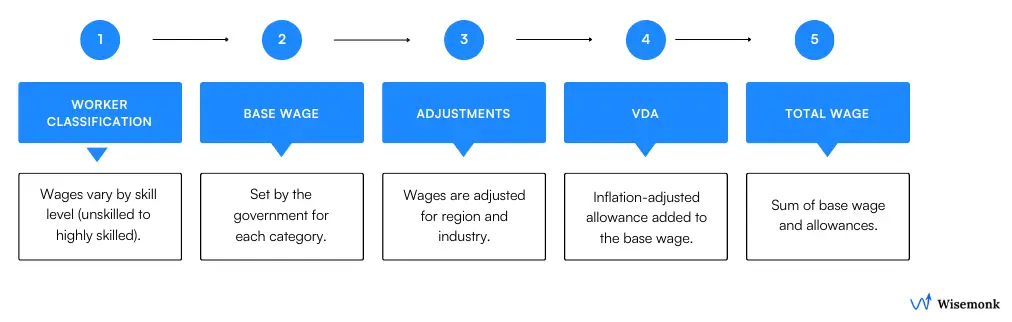
- Klassifizierung der Arbeitnehmer: Arbeitnehmer werden als ungelernte, angelernte, qualifizierte oder hochqualifizierte Arbeitskräfte eingestuft. Jede Kategorie hat einen anderen Mindestlohn, und für höhere Qualifikationen werden höhere Löhne gezahlt.
- Festlegung des Grundlohns: Die Regierung legt für jede Arbeitnehmerkategorie einen Grundlohn fest, der als Grundlage für den Mindestlohn dient.
- Anpassung an Region und Branche: Die Mindestlöhne werden weiter angepasst, je nachdem, ob der Job in einem städtischen oder ländlichen Gebiet stattfindet, und je nach Branche (wie Baugewerbe, Textilien oder Landwirtschaft). Dadurch wird sichergestellt, dass der Lohn den lokalen wirtschaftlichen Bedingungen und Branchenstandards entspricht.
- Hinzufügen der variablen Dearness Allowance (VDA): Um die Arbeitnehmer vor Inflation zu schützen, wird die variable Dearness Allowance zum Grundlohn hinzugerechnet. Der VDA wird regelmäßig auf der Grundlage des Verbraucherpreisindex (CPI) überarbeitet, sodass die Löhne mit den steigenden Lebenshaltungskosten Schritt halten.
- Zusammenfassung der Komponenten: Der gesamte Mindestlohn ist die Summe aus Grundlohn und Zulagen (hauptsächlich VDA und manchmal auch andere gesetzliche Zulagen wie HRA, falls zutreffend).
Beispiel, wie globale Arbeitgeber es verstehen
Ein in den USA ansässiges SaaS-Unternehmen Einstellung eines erfahrenen Backoffice-Mitarbeiters in Delhi würde sehen, dass die Berechnung so abläuft:
- Grundlohn (qualifiziert, städtisch): 21.917 €/Monat (~243,52 $/Monat)
- VDA-Anpassung: 494 €/Monat (~5,49 $/Monat)
Der endgültige Mindestlohn beläuft sich also auf 22.411 €/Monat (~249,01 $/Monat), was sich auf 862 €/Tag (~9,57 $/Tag) niederschlägt. Dieser Tarif gilt unabhängig davon, ob der Mitarbeiter aus der Ferne oder vor Ort innerhalb derselben Lohnzone arbeitet.
Wie hoch sind die tatsächlichen Arbeitgeberkosten bei der Einstellung zum Mindestlohn in Indien? [TOC = Wahre Arbeitgeberkosten]
Der Mindestlohn ist Ihre gesetzliche Untergrenze, nicht Ihre endgültigen Kosten. Gemäß dem Lohngesetzbuch und dem Sozialversicherungsgesetz (beide in Kraft ab dem 21. November 2025) muss jeder Arbeitgeber außerdem Folgendes leisten:
- PF-Beitrag des Arbeitgebers: 12% des Grundlohns (begrenzt auf 15.000€ Basislohn = mindestens 1.800€ pro Monat)
- Aufgelaufene Trinkgelder: 4,81% von Basic + DA pro Monat vom ersten Tag an
- ESI (wenn brutto ≤ 21.000€ pro Monat): Der Arbeitgeber trägt 3,25% zum Bruttogehalt bei
- Gesamtzahl der obligatorischen Ergänzungen: 15— 20% über dem Bruttogehalt
Beispiel:
Gemäß dem Lohngesetzbuch von 2019 (in Kraft am 21. November 2025) muss das Grundgehalt plus Pflegegeld mindestens 50% des gesamten CTC eines Mitarbeiters entsprechen.
Alle Zulagen, die den Teil, der nicht zur Grundausstattung gehört, auf über 50% erhöhen, werden als Löhne umgestuft, wodurch sich Ihre Verbindlichkeiten aus Altersvorsorge, Trinkgeld und Boni direkt erhöhen.
Darüber hinaus haben befristet Beschäftigte nach dem neuen Sozialversicherungsgesetz bereits nach einem Jahr Betriebszugehörigkeit (zuvor 5 Jahre) Anspruch auf Zuwendungen. Berücksichtigen Sie dies vom ersten Tag an in die gesamte Vertragskostenplanung.
Was das für globale Arbeitgeber bedeutet: Wenn in der Gehaltsstruktur Ihres indischen Mitarbeiters BasicPay unter 50% des CTC liegt, sind Sie ab November 2025 nicht konform. Überprüfen Sie vor Ihrem nächsten Gehaltszyklus alle Gehaltsabrechnungsstrukturen.
2x-Regel für Überstunden mit Kostenbeispiel:
Gemäß Abschnitt 14 des Lohngesetzbuches von 2019 muss jede Arbeit, die über die normalen Arbeitszeiten (48 Stunden/Woche oder 9 Stunden/Tag) hinausgeht, zum doppelten normalen Lohnsatz bezahlt werden. Für einen Facharbeiter in Delhi, der mindestens 22.411€ pro Monat bezahlt, beträgt der Tageslohn 862€. Jede Überstunde kostet den Arbeitgeber 1.724€ vor den gesetzlichen Beiträgen.
Lesen Sie mehr:“Regeln für Überstunden in Indien„
Was das für globale Arbeitgeber bedeutet: Die Haftung für Überstunden kann die monatlichen Lohnkosten erheblich erhöhen. Dokumentieren Sie die Arbeitszeiten vom ersten Tag an. Gemäß dem Kodex liegt die Beweislast für die Einhaltung der Vorschriften ausschließlich beim Arbeitgeber.
Wie ist der indische Mindestlohn reguliert? [TOC = Mindestlohnverordnung in Indien]
Seit vielen Jahren ist der Mindestlohn im Mindestlohngesetz von 1948 geregelt. Allerdings ist der Lohngesetzbuch, 2019 trat am 21. November 2025 in Kraft und ersetzte vier bestehende Arbeitsgesetze: den Mindestlohngesetz 1948, den Payment of Wages Act 1936, den Payment of Bonus Act 1965 und den Equal Remuneration Act 1976.
Der Kodex verbietet Arbeitgebern, Arbeitnehmer unter dem vorgeschriebenen Mindestlohn zu bezahlen, und verpflichtet sowohl die Zentralregierung als auch die Landesregierungen, die Mindestlöhne mindestens alle fünf Jahre zu überarbeiten.
Bevor der Lohnkodex diese Regeln konsolidierte, gab es in Indien über 1.200 verschiedene Mindestlohnkategorien in Bundesstaaten, Branchen und Qualifikationsstufen — eines der fragmentiertesten Lohnsysteme der Welt.
Der Kodex dehnt auch den Mindestlohnschutz auf Teilzeitbeschäftigte aus. Der Anspruch wird anteilig auf der Grundlage der geleisteten Arbeitsstunden berechnet. Die Bestimmung der allgemeinen Anwendbarkeit finden Sie in Abschnitt 5 des Lohngesetzbuches.
Warum hat Indien keinen einzigen nationalen Mindestlohn? [TOC = Kein nationaler Mindestlohn]
In unserer Erfahrung mit der Unterstützung von Unternehmen in ganz Indien haben wir festgestellt, dass das Fehlen eines einzigen nationalen Mindestlohns auf die enorme wirtschaftliche und soziale Vielfalt des Landes zurückzuführen ist.
Die föderale Struktur Indiens ermächtigt sowohl die Zentralregierung als auch die Regierungen der Bundesstaaten, Mindestlöhne festzulegen, was Flexibilität ermöglicht, um den lokalen Unterschieden bei den Lebenshaltungskosten und den Bedürfnissen der Branche Rechnung zu tragen.
Hauptgründe für diesen Ansatz:
- Vielfältige wirtschaftliche Bedingungen: Die Staaten unterscheiden sich stark in Bezug auf Lebenshaltungskosten, industrielle Entwicklung und Bedingungen auf dem Arbeitsmarkt für qualifizierte Arbeitskräfte.
- Rechtlicher Rahmen: Das Mindestlohngesetz von 1948 und das Lohngesetzbuch von 2019 übertragen sowohl der Zentralregierung als auch den Landesregierungen die Befugnis zur Lohnfestsetzung.
- Sektor- und Regionsspezifität: Die Mindestlöhne sind auf verschiedene Sektoren, Qualifikationsniveaus und sogar auf städtische und ländliche Gebiete innerhalb der Bundesstaaten zugeschnitten.
Basierend auf unseren umfangreichen Untersuchungen trägt dieses dezentrale System dazu bei, dass die Lohnstandards in den vielen Regionen und Branchen Indiens relevant und fair bleiben.
Was sind die Strafen für die Nichtzahlung des Mindestlohns in Indien? [TOC = Strafen bei Nichteinhaltung der Vorschriften]
Basierend auf unseren umfangreichen Recherchen und direkten Erfahrungen mit der Einhaltung von Arbeitsvorschriften können wir bestätigen, dass die Nichtzahlung des vorgeschriebenen Mindestlohns in Indien schwerwiegende rechtliche Konsequenzen für Arbeitgeber haben kann. Die Regierung hat strenge Strafen verhängt, um sicherzustellen, dass Industriearbeiter ihren rechtmäßigen Lohn erhalten.
Wichtige Strafen bei Nichteinhaltung der Vorschriften:
Strafen für die Nichteinhaltung der Mindestlohngesetze in Indien einschließlich Bußgeldern, rechtlichen Schritten und Freiheitsstrafen.
.webp)
- Erster Verstoß: Arbeitgeber, die die Mindestlohnbestimmungen nicht einhalten, müssen mit einer Geldbuße von bis zu 50.000$ rechnen.
- Zweiter Verstoß innerhalb von 5 Jahren: Wiederholte Verstöße innerhalb von fünf Jahren werden je nach Schwere der Straftat mit einer Geldstrafe von bis zu 40.000€ und/oder einer Freiheitsstrafe von bis zu einem Monat geahndet.
- Entschädigung bei Unterzahlung: Wird eine Unterzahlung festgestellt, kann die Behörde dem betroffenen Arbeitnehmer direkt eine Entschädigung in Höhe des Zehnfachen des Fehlbetrags gewähren.
- Lohnrückzahlungen: Alle Lohnausfälle können bis zu drei Jahre nach Einreichung des Antrags, nicht erst ab dem Datum der Beschwerde, ausgeglichen werden.
- Beweislast: Die Beweislast liegt ausschließlich beim Arbeitgeber. Das Fehlen ordnungsgemäßer Lohnaufzeichnungen oder Unterlagen wird im Rahmen des Kodex als Schuldvermutung behandelt.
Beispiel aus der Praxis: So sieht eine Nichteinhaltung von Vorschriften aus
Fallreferenz, Vishal Mega Mart (Airplaza Retail Holdings Pvt. Ltd.), April 2025: Die Tochtergesellschaft des Unternehmens erhielt vom Assistant Labour Commissioner Court in Kasganj, Uttar Pradesh, eine Rückforderungsanordnung in Höhe von 12.90.146€ wegen Verstoßes gegen das Mindestlohngesetz von 1948. Der Fall wurde im Rahmen der Börsennotierung von SEBI offengelegt.
Quelle: Unternehmensankündigung von TipRanks
Unserer Erfahrung nach vermeidet eine schnelle Einhaltung der Mindestlohngesetze nicht nur diese Strafen, sondern trägt auch dazu bei, einen positiven Ruf am Arbeitsplatz und das Vertrauen der Mitarbeiter aufrechtzuerhalten.
Was sind die neuesten Änderungen der Mindestlohngesetze für 2026? [TOC=Letzte Aktualisierungen]
Basierend auf unseren umfangreichen Recherchen und der Überprüfung offizieller Aktualisierungen hat 2026 die Mindestlohngesetze in ganz Indien erheblich geändert. Mehrere Bundesstaaten haben ihre Mindestlohnsätze überarbeitet, um den steigenden Lebenshaltungskosten und den wirtschaftlichen Bedingungen Rechnung zu tragen.
Aktuelle Aktualisierungen der indischen Mindestlohngesetze, darunter VDA-Anpassungen, Überarbeitungen auf Landesebene und der Lohnkodex 2019.
- Überarbeitungen auf Landesebene: Delhi erhöhte seinen Mindestlohn mit Wirkung zum 1. Oktober 2025 auf 18.456€ pro Monat (205,07$) für ungelernte Arbeitnehmer und 22.411€ pro Monat (249,01$) für Fachkräfte. Staaten wie Punjab, Goa, Andhra Pradesh, Bihar und Karnataka haben ebenfalls neue Lohnbescheide für 2025 herausgegeben.
- Grundvergütungsregel von 50% (gültig ab November 2025): Basic Pay + DA muss mindestens 50% des gesamten CTC ausmachen. Alle Zulagen, die diesen Schwellenwert überschreiten, werden in Löhne umgegliedert, wodurch sich Ihre Verbindlichkeiten aus Altersvorsorge, Trinkgeld und Boni erhöhen. Weltweit tätige Arbeitgeber müssen die Gehaltsabrechnungen in Indien umgehend überprüfen.
- Variables Pflegegeld (VDA): Die Zentralregierung passt den VDA weiterhin regelmäßig auf der Grundlage des Verbraucherpreisindex an, um die Löhne vor Inflation zu schützen.
- Auf dem Weg zu einem existenzsichernden Lohn: Derzeit laufen politische Diskussionen über den Übergang vom Mindestlohnsystem zu einem Rahmen für existenzsichernde Löhne, der grundlegende Lebenshaltungskosten wie Wohnen, Essen, Gesundheitsversorgung und Bildung berücksichtigt.
- Lohngesetzbuch, 2019: Mit dieser Gesetzgebung wurden die Lohngesetze zum 21. November 2025 vereinheitlicht, sodass jeder Arbeitnehmer in Indien zum ersten Mal einen gesetzlichen Anspruch auf Mindestlöhne hat.
- Lohnzahlung bis zum 7. eines jeden Monats: Der Kodex schreibt nun die Gehaltsfreigabe für alle Arbeitgeber bis zum 7. des Folgemonats vor. Wird dies auch nur um einen Tag versäumt, werden gesetzliche Strafen verhängt.
[Quelle: Regierung von Indien, Presseinformationsbüro]
Existenzlohn gegen Mindestlohn in Indien
Der Mindestlohn ist eine gesetzliche Untergrenze, das Mindeste, das ein Arbeitgeber legal zahlen kann. Ein existenzsichernder Lohn ist eine Schätzung dessen, was ein Arbeitnehmer tatsächlich benötigt, um Essen, Wohnen, Gesundheitsversorgung und Bildung abzudecken.
Die indische Regierung hat diese Lücke erkannt. Derzeit laufen politische Diskussionen über die Umstellung auf ein existenzsicherndes Lohnmodell, obwohl bis März 2026 noch kein gesetzlicher Zeitplan bestätigt wurde.
Nachdem wir mehrere globale Unternehmen durch diese Veränderungen begleitet haben, betonen wir, wie wichtig es ist, sowohl die zentralen als auch die staatlichen Benachrichtigungen zu überwachen, um die Einhaltung der Vorschriften und eine faire Vergütung im Jahr 2026 sicherzustellen.
Wie wirken sich Indiens neue Arbeitsgesetze auf den Mindestlohn im Jahr 2026 aus? [TOC=Auswirkungen der neuen Arbeitsgesetzbücher]
Indien hat am 21. November 2025 offiziell alle vier neuen Arbeitsgesetzbücher eingeführt, einschließlich des Lohngesetzes von 2019, das endlich jedem Arbeitnehmer im Land einen gesetzlichen Anspruch auf Mindestlohn einräumt.
Aufgrund unserer Erfahrung bei der Unterstützung globaler Unternehmen bei der Gehaltsabrechnung in Indien ist dies eine der wichtigsten regulatorischen Veränderungen, die Arbeitgeber verstehen sollten.
Wichtige Änderungen, die sich auf den Mindestlohn im Jahr 2026 auswirken
Folgendes müssen globale Arbeitgeber wissen:
- Universell einsetzbar: Die Mindestlohnregeln gelten jetzt für alle Arbeitnehmer, nicht nur für Arbeitnehmer in „Linienbetrieben“. Dadurch wird der Schutz- und Compliance-Umfang erheblich erweitert.
- Nationaler Mindestlohn: Die Zentralregierung muss jetzt einen nationalen Mindestlohn festlegen, und Staaten können ihn rechtlich nicht unterschreiten. Einzelne Staaten werden weiterhin ihre eigenen Tarife veröffentlichen, die über dieser Untergrenze liegen.
- Einheitliche Lohndefinition (50% -Regel): „Löhne“ haben jetzt in ganz Indien eine standardisierte Definition. Das Grundgehalt muss sich ergeben mindestens 50% des gesamten CTC, wodurch die Sozialversicherungsbeiträge (PF, Trinkgeld) erhöht und die Gehaltsabrechnung transparenter wird.
Für einige Unternehmen mag dies zwar die Gehälter verringern, aber die langfristigen Leistungen werden gestärkt. - Rechtzeitige Lohnzahlung: Arbeitgeber sind nun gesetzlich verpflichtet, alle Arbeitnehmer pünktlich zu bezahlen, nicht nur diejenigen, die bestimmten Kategorien angehören.
- Die landesspezifischen VDA-Revisionen werden fortgesetzt: Selbst mit einem zentralen Lohnrahmen überarbeiten die Staaten ihre variable Dearness Allowance (VDA) immer noch auf der Grundlage der lokalen Inflation. So haben beispielsweise Odisha, Goa, Jharkhand und Andhra Pradesh mit Wirkung zum 1. Oktober 2025 neue VDA-Mitteilungen herausgegeben.
Angesichts der Tatsache, dass Indiens Lohnreformen Gestalt annehmen, besteht der klügste Schritt für Arbeitgeber darin, auf dem Laufenden zu bleiben und die Gehaltsabrechnungsstrukturen frühzeitig anzupassen, anstatt zu reagieren, wenn Compliance-Probleme auftauchen.
Wo finden Sie offizielle Updates und Benachrichtigungen zum Mindestlohn? [TOC=Vertrauenswürdige Quellen]
Unserer Erfahrung nach stammen die genauesten und aktuellsten Informationen zu Mindestlohnsätzen und staatlichen Vorschriften in Indien aus offiziellen Regierungsquellen. Sowohl die zentralen als auch die staatlichen Behörden veröffentlichen regelmäßig Benachrichtigungen und Änderungen online.
Vertrauenswürdige Quellen für offizielle Updates:
- Website des Hauptarbeitskommissars (Central):
Hier finden Sie Mindestlohnbenachrichtigungen der Zentralregierung, Verordnungen zur variablen Dearness Allowance (VDA) und geplante Beschäftigungsquoten. [Hauptarbeitskommissar (Zentral)] - Ministerium für Arbeit und Beschäftigung:
Greifen Sie auf zentrale Lohngesetze, Regeln und aktuelle Richtlinien zu. [labour.gov.in] - Mindestlohngesetz von 1948 (Volltext):
Überprüfen Sie das Grundgesetz und seine Bestimmungen zur Lohnfestsetzung und -revision. [clc.gov.in/acts-rules/minimum-lohn-gesetz] - Benachrichtigungen des staatlichen Arbeitsministeriums:
Jeder Staat veröffentlicht seine eigenen Lohnbenachrichtigungen und -revisionen. Eine konsolidierte Übersicht der jüngsten Aktualisierungen in den einzelnen Bundesstaaten finden Sie unter: [Simpliance]
Konsultieren Sie diese offiziellen Portale für die neuesten Benachrichtigungen und Änderungen, um die zuverlässigste Einhaltung der Vorschriften zu gewährleisten.
Wie kann Wisemonk helfen? [TOC=Wie Wisemonk hilft]
Weiser Mönch ist ein führendes Employer of Record (EOR) -Service in Indien engagiert sich für die Unterstützung globaler Unternehmen Talente in Indien einstellen, bezahlen und managen ohne dass eine lokale Einheit erforderlich ist. Mit unserer umfassenden Expertise in Indisches Arbeitsrecht und Einhaltung der Gehaltsabrechnung, machen wir es Unternehmen leicht, die Mindestlohnvorschriften in allen Bundesstaaten vollständig einzuhalten und sicherzustellen, dass Ihre Belegschaft immer korrekt und pünktlich bezahlt wird.
Die wichtigsten Funktionen, die wir für die Einhaltung des Mindestlohns anbieten:
- Automatisierte Gehaltsabrechnung, die immer die neuesten staatlichen Mindestlohnaktualisierungen berücksichtigt.
- Compliance-Fachwissen in mehreren Bundesstaaten, sodass Sie keine regulatorischen Änderungen verpassen, unabhängig davon, wo Ihr Team ansässig ist.
- Gesetzliche Beiträge werden von Anfang bis Ende abgewickelt (EPF, ESI, Trinkgeld, Gewerbesteuer usw.).
- Transparente, revisionssichere Aufzeichnungen für alle Lohn- und Compliance-Unterlagen.
Indien bleibt zwar unsere stärkste Stärke, aber wir expandieren stetig in wichtige globale Märkte wie die USA und Großbritannien. Mit Wisemonk erhalten Sie einen Partner, der Ihre Geschäftstätigkeit in Indien unterstützen kann und Ihnen gleichzeitig dabei hilft, Einstellungen und Gehaltsabrechnungen in mehreren Ländern zu skalieren.
Sind Sie bereit, die Gehaltsabrechnung in Indien zu vereinfachen und die vollständige Einhaltung der Vorschriften sicherzustellen? Nehmen Sie noch heute Kontakt mit uns auf und lassen Sie uns die Komplexität bewältigen, damit Sie sich auf das Wachstum Ihres Unternehmens konzentrieren können!
Häufig gestellte Fragen
Was ist der Mindestlohn in Indien in US-Dollar?
Indien hat keinen einzigen nationalen Mindestlohn. Er variiert je nach Bundesland, Qualifikationsniveau, Branche und Standort. Die Zentralregierung legt einen Mindestlohn von 178€ pro Tag (2,13$) fest, wobei die Staaten je nach den örtlichen Bedingungen und Lebenshaltungskosten höhere Löhne festlegen dürfen.
Wie oft wird der Mindestlohn in Indien überarbeitet?
Gemäß dem Lohngesetzbuch von 2019 sind sowohl die Zentralregierung als auch die Landesregierungen verpflichtet, die Mindestlöhne mindestens alle fünf Jahre zu überarbeiten. In der Praxis wird die variable Dearness Allowance (VDA) alle sechs Monate, jedes Jahr im April und Oktober, auf der Grundlage der Änderungen des Verbraucherpreisindex überarbeitet. Das bedeutet, dass der effektive Mindestlohn in den meisten Bundesstaaten zweimal jährlich aktualisiert wird. Arbeitgeber sollten die Benachrichtigungen des staatlichen Arbeitsministeriums abonnieren oder ein Compliance-Tool verwenden, um auf dem Laufenden zu bleiben.
Ist der Mindestlohn in Indien 26 Tage oder 30 Tage?
In Indien werden die Mindestlöhne in der Regel auf der Grundlage eines 26-tägiger Arbeitsmonat, nicht 30 Tage. Dies bedeutet, dass der monatliche Mindestlohn durch 26 geteilt wird, um den Tageslohn zu ermitteln, was der üblichen Praxis entspricht, Arbeitnehmern einen bezahlten freien Tag pro Woche zu gewähren. In einigen Bundesstaaten oder Einrichtungen kann es Abweichungen geben, aber die 26-Tage-Regel wird häufig befolgt, um die Einhaltung der Vorschriften und die Lohnberechnung zu gewährleisten.
Wie können globale Unternehmen sicherstellen, dass sie den indischen Mindestlohn korrekt zahlen?
Globale Unternehmen müssen Indiens folgen landesspezifische Mindestlohngesetze, die je nach Schwierigkeitsgrad und Standort variieren. Der einfachste Weg, konform zu bleiben, ist die Zusammenarbeit mit einem Rekordarbeitgeber (EOR) das die Gehaltsabrechnung, Steuern und gesetzliche Aktualisierungen verwaltet. Erfahren Sie mehr in unserem Leitfaden „Employer of Record“ und Vergleich der besten EOR-Unternehmen.
Wie hoch ist der Stundensatz in Indien?
Der Mindestlohn pro Stunde in Indien hängt vom Bundesstaat und der Berufsgruppe ab. Als Referenz gilt der zentrale Mindestlohn von ₹178 pro Tag übersetzt in etwa 22,25€ (0,27$) pro Stunde für einen 8-Stunden-Arbeitstag, aber die tatsächlichen Tarife können in vielen Bundesstaaten und für qualifizierte Stellen höher sein.
Gelten indische Mindestlohngesetze für Telearbeiter, die von Indien aus für US-Unternehmen arbeiten?
Ja. Die indischen Mindestlohngesetze gelten je nachdem, wo der Arbeitnehmer physisch arbeitet, nicht darauf, wo der Arbeitgeber gegründet ist. Wenn Ihr Arbeitnehmer von Indien aus für ein US-Unternehmen arbeitet, das vollständig an einem anderen Standort tätig ist, gilt der landesspezifische Mindestlohn für seinen Standort und seine Position. Der Lohnkodex von 2019 deckt dieses Szenario ausdrücklich ab.
Was hat sich am indischen Mindestlohn nach November 2025 geändert?
Das Lohngesetz von 2019 trat am 21. November 2025 in Kraft und ersetzte das Mindestlohngesetz von 1948. Wichtigste Änderungen: Der Mindestlohn gilt jetzt für alle Arbeitnehmer, der nationale Mindestlohn ist gesetzlich vorgeschrieben, das Grundgehalt plus DA muss mindestens 50% des CTC betragen, und befristet Beschäftigte erhalten nach einem Jahr ein Entgelt.

.png)











.webp)
.webp)


.webp)
.webp)
.webp)


.webp)
.webp)

.webp)


.webp)


.webp)

.webp)


.webp)



.webp)

.webp)

.webp)

.webp)



.webp)
.webp)

%20Explained.webp)

.webp)



%20(1).webp)
.webp)

%20in%20India%20(2024).webp)

.webp)
.webp)
.webp)


%20(1).webp)




%201.webp)


%20in%20India.webp)


%20(1).webp)


.webp)

.webp)
.webp)
.webp)