

_MomentumLeader_Leader.svg)

- An Employer of Record (EOR) in India is a third-party company that becomes the legal employer of your Indian hires, handling employment contracts, payroll, statutory benefits, and compliance while you manage the actual work.
- The cost of EOR in India ranges from $99 to $200 per employee per month with Indian EOR providers like Wisemonk, while global EORs charge around $499 to $699 for the same role.
- As of April 2026, India’s payroll framework requires higher compliance with the 50% basic salary rule increasing the base for EPF, gratuity, and other contributions.
- When choosing an EOR for India, prioritize India-specific expertise over global generalists, confirm they own a local legal entity, and verify dedicated HR support, CTC optimization capabilities, and transparent pricing.
Need help with Employer of Record in India? Reach out to us today!
Discover how Wisemonk creates impactful and reliable content.
Hiring in India offers global companies access to world-class engineering talent at a fraction of US or UK hiring costs. But navigating Indian labor laws, payroll compliance, and statutory requirements without a local entity is where most foreign companies get stuck.
Whether you're a US, UK, or any other global company looking to hire in India, an Employer of Record (EOR) is the fastest and most compliant way to build your team there without setting up a legal entity.
This guide covers everything you need to know about using an Employer of Record in India, from how it works and what it costs, to compliance risks, provider selection, and step-by-step hiring.
India at a Glance
- Population: 1.47 billion
- Currency: Indian Rupee (INR)
- Capital: New Delhi
- Business languages: English & Hindi (plus 20+ officially recognized regional languages)
- GDP (Nominal): ≈ $4.1–4.2 trillion
- Key talent hubs: Bengaluru, Hyderabad, Pune, Mumbai, Delhi NCR, Chennai
What is an EOR in India?[toc=What is EOR]
An Employer of Record (EOR) in India is a third-party company that legally employs workers on your behalf while you stay in full control of their day-to-day work. You find the talent, set the direction, and manage performance.
The EOR handles everything else, from employment contracts and payroll management to tax filings, statutory benefits, and compliance with Indian labor laws.
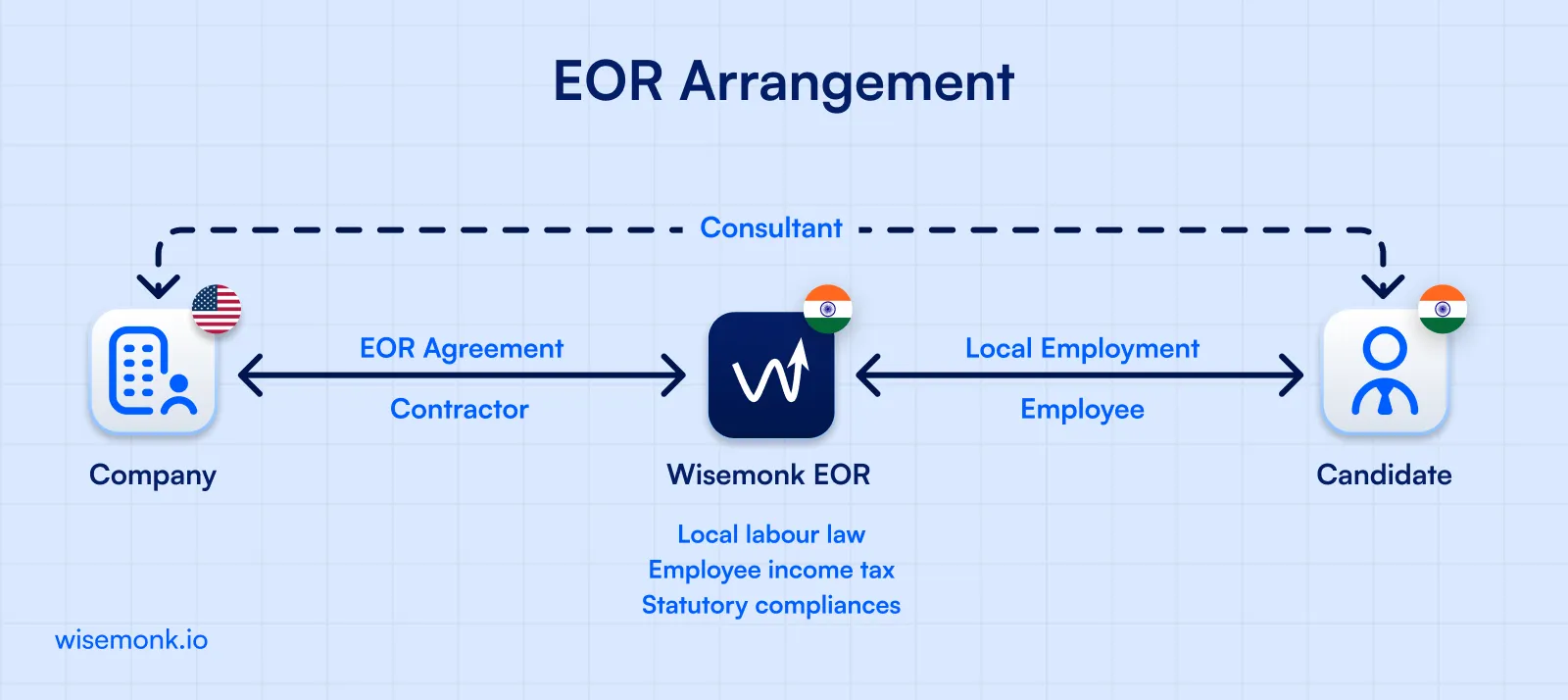
In practice, the EOR becomes the legal employer on paper. Your team member works for you in every meaningful way, but the EOR carries the legal and administrative burden of employing them in India.
Here's how the split works:
- You handle: Hiring decisions, role scope, day-to-day management, performance reviews, and project direction.
- The EOR handles: Drafting compliant employment contracts, running payroll in INR, filing payroll taxes, managing statutory contributions like Employees' Provident Fund (EPF) and Employee State Insurance (ESI), administering employee benefits, and ensuring ongoing compliance with Indian employment laws and local regulations.
For US and UK companies looking to hire in India without setting up a local entity, this is the most straightforward path to building a compliant team on the ground.
Why do global companies use an Employer of Record India?[toc=Why EOR in India]
Most US and UK companies use an EOR in India to hire fast, stay compliant with Indian labor laws, and build high-retention teams without setting up a local entity or managing the administrative burden themselves.
Here's why EOR is the model global companies consistently choose:
- Hire in days, not months: Entity setup in India takes 3 to 6 months. With an EOR, you can onboard your first hire in as little as 2 to 7 days, with no incorporation or government registration required.
- Access India's talent pool without the operational overhead: India has one of the deepest engineering talent pools in the world. An EOR handles the 40+ central labor laws, state-specific regulations, and statutory filings so you don't have to.
- Lower attrition through a better employee experience: Having helped 300+ global companies build teams in India, we've consistently seen that employees who receive accurate benefits, on-time payroll, and dedicated HR support simply stay longer.
- Win better talent with structured employment: Top engineers in Bangalore or Hyderabad hold multiple offers. A compliant employment contract, optimized CTC structure, and proper statutory benefits help US and UK companies compete and close the hire.
What compliance risks does an EOR in India eliminate?
Here's something we've learned after helping sevral global companies set up teams in India - most founders and HR leaders don't see these risks coming until they're already in trouble.
Hiring in India without proper structure exposes your company to three specific compliance risks. The good news? A well-structured EOR takes all three off your plate completely.
Here's a quick breakdown:
Companies that attempt to manage payroll directly or handle employees without an Employer of Record (EOR) often increase their Permanent Establishment (PE) risk without realizing it. An EOR separates employment and payroll from your company's legal presence, a distinction that is more significant than many people realize.
When Wisemonk EOR acts as the legal employer, this separation is clear and documented. We have established this structure for hundreds of global teams, eliminating the need for you to develop it independently.
How does an Employer of Record in India work?[toc=How EOR Works]
When a global company uses an EOR in India, the EOR becomes the legal employer, drafts a compliant employment contract, onboards the employee, and handles all payroll, taxes, and statutory filings every month.
The client company simply manages the work.
Step 1: You Share the Role Details With the EOR
You share the role details, compensation structure, and proposed start date with the EOR provider. The EOR reviews the CTC breakdown, confirms statutory contribution requirements, and sets up the employment framework before anything is signed.
Step 2: The EOR Drafts a Locally Compliant Employment Contract
The EOR prepares a written employment agreement compliant with Indian labor law and the applicable state-level Shops and Establishments Act. This is not a generic template. The contract is state-specific, covering the employee's work location, applicable leave entitlements, and local termination rules.
Step 3: The EOR Onboards Your Employee and Registers Them for Statutory Benefits
The EOR collects all required KYC documents from your employee, including PAN, Aadhaar, and bank account details, and completes PF and ESI registration with the relevant authorities. Your employee is formally onboarded as a full-time statutory employee from day one.
Step 4: The EOR Runs Monthly Payroll and Handles All Tax Filings
Every month, the EOR processes the full CTC breakdown, calculates TDS under the applicable tax regime, deducts PF and ESI contributions, and disburses net pay directly to your employee's bank account in INR.
From what we've seen at Wisemonk managing $20M+ in Indian payroll, getting the salary structure right from the start makes a significant difference to both compliance and employee take-home pay.
Step 5: The EOR Manages Ongoing Compliance So You Don't Have To
The EOR handles all statutory filings on your behalf, including monthly TDS deposits, PF and ESI remittances, professional tax where applicable, leave tracking, benefits administration, and any regulatory updates triggered by state-level labor law changes. You never have to track an Indian statutory deadline.
Step 6: The EOR Handles Offboarding and Final Settlement When an Employee Exits
When an employee exits, the EOR manages the notice period in line with the contract and applicable Shops and Establishments Act, calculates the full and final settlement, processes gratuity if the employee has completed five or more years of service, and closes all statutory registrations cleanly.
How much does an Employer of Record in India cost?[toc=Cost of EOR in India]
Understanding the total cost of hiring through an Employer of Record in India requires looking beyond the service fee alone.
Here's the complete picture upfront for EOR pricing:
Total cost = Salary + 15–20% statutory contributions + EOR fee
Global EOR platforms like Remote or Deel typically charge $499 to $699/employee/month for the same India coverage.
Wisemonk EOR starts at $99/employee/month, with no hidden FX markups or surprise fees.
Here's what each component covers:
- EOR service fee: The fixed monthly fee covering payroll processing, HR management, and compliance. Local India-specialist providers charge significantly less than global platforms.
- Employee salary: The agreed CTC paid to your employee. This is your largest cost and is separate from the EOR fee.
- Statutory employer costs: Mandatory contributions including PF (12% of basic salary), ESI (3.25%), gratuity provision (4.81%), and statutory bonus. These add roughly 15–20% on top of gross salary.
- Benefits and add-ons: Health insurance, equipment procurement, and advanced HR tools are optional and charged separately if chosen.
- Setup or onboarding fee: A one-time cost some providers charge. Wisemonk EOR waives this entirely.
Read more: "What is the Cost of Employer of Record (EOR) in India?"
Try our fully loaded cost calculator now and take the first step towards building your world-class team in India: Salary Calculator India: Simplify Your Take-Home Pay Calculation.
How do you choose the right Employer of Record in India?[toc=Choose the Right Provider]
The first and most important distinction is whether the provider is an India specialist or a global platform that happens to cover India among 100+ other countries.
A global EOR may have India checked off on a country list, but their compliance depth, local HR support, and state-level expertise will rarely match a provider focused exclusively on India.
Here's what actually matters when evaluating providers for India specifically:
1. India-specific expertise vs. global generalist
A provider managing employment across 150 countries splits its attention across all of them. India has 40+ central labor laws and state-specific Shops and Establishments Acts that vary by location.
You want a provider whose team lives and breathes this, not one that treats India as one row in a spreadsheet.
2. Local entity ownership.
Choose an EOR with a wholly owned entity in India. Local ownership improves compliance, ensures greater control, and avoids intermediary fees.
Some providers use third-party aggregators to employ workers in India, which creates an additional layer of risk and slower response times.
3. Dedicated HR support model
The difference between a ticket queue and a dedicated HR manager is significant when your employee has a payroll dispute or a benefits question.
We've had clients come to Wisemonk EOR from global platforms specifically because they couldn't get a human on the phone. Ask exactly how support is structured.
4. Tax optimization capabilities
This is something global EORs almost never offer at depth. A good India-specialist EOR structures employee CTC to legally maximize take-home pay through optimized allowance breakdowns. This directly improves employee satisfaction and retention.
5. Onboarding speed
Most global providers can onboard in 2 to 14 days. Ask for specifics, not marketing claims.
Wisemonk offers a highly accelerated onboarding process for hiring employees in India, with most employees fully onboarded in under 48 hours to 3 days.
6. Pricing transparency
Watch for FX markups, onboarding fees, and benefits administration charges that don't appear in the headline price. Wisemonk EOR starts at $99/employee/month with no hidden fees.
7. G2 ratings and reviews
Real user reviews on G2 are one of the most reliable signals, especially around customer support quality and payroll accuracy.
Wisemonk EOR holds a 4.8/5 rating on G2 with recognition for Fastest Implementation and Easiest To Do Business With.
Why state-level compliance depth matters
India isn't one uniform employment market. An employee in Karnataka operates under different leave rules, professional tax rates, and Shops Act requirements than one in Maharashtra or Delhi. A provider without genuine state-level compliance depth will either get this wrong or push the risk back to you.
What are the key aspects of payroll in India?[toc=Payroll in India]
Managing payroll in India is a critical responsibility for any employer and, in our experience supporting global teams, we have found that Indian payroll is uniquely complex due to frequent regulatory updates and strict local compliance requirements. An Employer of Record (EOR) in India takes over this burden, ensuring every aspect is handled accurately and on time.
1. Employee salaries structures in India
In India, employee salaries follow the Cost to Company (CTC) model, which includes fixed pay (basic salary, HRA, conveyance allowance), variable pay (bonuses, commissions), statutory benefits (EPF contributions, health insurance), and deductions that determine the final take-home pay. Understanding how CTC breaks down into gross and net salary helps you structure competitive compensation packages.
Learn more about Indian salary components in our detailed guide on Paystubs in India.
2. Wages in India
Wages in India include basic salary, allowances, bonuses, and statutory components, regulated by federal and state-level minimum wage laws, professional tax rules, and social security contributions. Accurate payroll handling ensures compliance with these varying regulations across different states and industries.
For current wage requirements across Indian states, check our comprehensive India Minimum Wage Guide.
3. Statutory Deductions and Contributions
Indian payroll requires mandatory deductions including Provident Fund (EPF) for retirement savings, Employee State Insurance (ESI) for medical coverage, Professional Tax in applicable states, and Tax Deducted at Source (TDS) for income tax. Your EOR handles all these calculations and filings automatically to ensure full compliance.
4. Payroll Compliance Across Indian States
Payroll rules in India are not uniform. Each state has its own professional tax rates, labor welfare fund requirements, and leave encashment policies. A company hiring employees across cities like Bangalore, Mumbai, and Delhi needs to comply with different state level rules on top of the central regulations. An EOR with multi state expertise ensures that every payroll run accounts for these local variations, so your employees are paid accurately and your company stays compliant no matter where your team is located.
Want payroll done right (and without tax-season migraines)? Dive into our guide on Payroll Compliance in India.
What taxes should employers and employees be aware of in India?[toc=Taxes in India]
From our experience managing $20M+ in Indian payroll across global companies, we can tell you this much - Indian tax regulations aren't hard once you know the structure. The problem is that most companies don't know the structure until something goes wrong.
Here’s a fully updated (April 2026) breakdown of every tax and statutory contribution you need to know when hiring in India:
One thing we've noticed consistently across our client base - the companies that get these deductions right from month one have significantly fewer payroll disputes and happier employees. It sounds basic, but it makes a real difference to retention.
An Employer of Record (EOR) or specialized payroll provider like Wisemonk handles all of the above - managing calculations, filings, remittances, and keeping you updated as regulations change. You focus on the work; the EOR handles the paperwork.
What are the employee benefits in India?[toc=Employee Benefits]
From our experience helping hundreds of global companies expand into India, employee benefits are essential for keeping talent in a competitive hiring landscape. Indian labor law requires mandatory benefits for most employees, while extra benefits help attract top talent in the private sector.
1. Statutory Benefits
Statutory benefits in India include the Employees' Provident Fund (EPF) for retirement savings, Employee State Insurance (ESI) for healthcare coverage, gratuity after 5 or more years of service, paid annual leave (15 to 21 days depending on the state), sick leave (7 to 12 days), maternity leave (26 weeks for female employees for their first two pregnancies), and mandatory bonus payments. These benefits ensure job security and employee rights during significant life events.
Note: India does not have statutory paternity leave in the private sector.
2. Supplementary Benefits
Supplementary benefits and insurance that go beyond legal requirements include improved health insurance with family coverage, life insurance, performance bonuses, flexible work options, meal and transport allowances, wellness programs, and professional development. These perks help companies boost employee well-being and retention in competitive markets.
If you're looking to dive deeper into how these benefits can impact your talent strategy, check out our Employee Benefits in India: A Comprehensive Guide, it’s a handy resource to help you stay ahead in the competitive talent market.
What are the standard leave policies in India?[toc=Leaves Policies]
This is one of those areas where we've seen global companies trip up more often than you'd expect. India's labor laws mandate specific leave entitlements, and they vary by state, so what works in Karnataka might not be compliant in Maharashtra.
After managing HR compliance for 2,000+ employees across India, here's the quick-reference breakdown we wish every global HR leader had on day one:
For a deeper dive into leave entitlements, national holidays, and best practices across India, check out our detailed guide: Understanding Leave Policy Laws and Holidays in India.
Here's a practical tip from our team: getting leave policies right at the offer stage itself builds trust with your Indian hires. We've seen candidates compare leave structures across offers, especially maternity leave and carry-forward policies. It's a bigger deal than most global companies realize.
Note: India does not have statutory paternity leave in the private sector. Leave entitlements vary by state, use Wisemonk's Holiday & Leave Policy Tool for state-specific details.
How does an EOR ensure IP protection when hiring employees in India?[toc=IP Protection]
Employer of Record services India include comprehensive IP protection clauses in employment contracts to ensure all work created by your Indian employees belongs to your company, not the EOR or the employee.
- IP assignment built into employment contracts: The EOR includes clauses assigning all intellectual property rights (patents, trademarks, designs, copyrights) from employees to your company as part of standard employment agreements.
- Indirect IP assignment model: Employees assign IP to the EOR first, then the EOR immediately assigns it to your company through the Master Services Agreement, reducing permanent establishment and co-employment risks.
- Proper employee classification: Using an EOR ensures workers are correctly classified as employees rather than contractors, which matters because Indian contractors automatically own their IP unless contracts specify otherwise.
- Confidentiality and NDA protection: Employment contracts include non-disclosure agreements and confidentiality clauses enforced under the Indian Contract Act of 1872.
- Compliance with Indian IP laws: The EOR ensures contracts specify assignment territory and term (avoiding India's 5-year default limitation), include moral rights waivers under the Copyright Act, and follow all statutory requirements.
Your EOR handles the legal complexity of IP protection so you maintain full ownership of all innovations, code, designs, and other intellectual property created by your Indian team.
What are the key steps involved in terminating employees in India?[toc=Termination in India]
India doesn't recognize at-will employment, so termination procedures must follow the Industrial Relations Code, 2020 with proper notice periods and documentation. Here's what the process involves:
- Provide proper notice period: Give 30-90 days' notice for confirmed employees or 15 days for probationary employees, or offer payment in lieu of notice.
- Follow due process for misconduct cases: Issue a show-cause notice, conduct a domestic inquiry, document findings, and terminate only if misconduct is proven.
- Settle all dues within 2 working days: Pay final salary, unused leave encashment, reimbursements, statutory bonuses, and gratuity (15 days' wages per year for 5+ years of service, capped at ₹20 lakhs).
- Issue required documentation: Provide termination letter, experience certificate, full-and-final statement, and retain employee records for 3 years.
- Let your EOR handle the entire process: The EOR manages compliance with the Industrial Relations Code, calculates settlements, issues documentation, and retains records to eliminate legal risks.
Note: Businesses with over 300 workers must get government approval for mass layoffs or closures under the regulations set to take effect in 2026.
2026 Compliance Note: Companies using EOR services in India should be aware that terminating 300+ workers requires prior government approval under the Industrial Relations Code, 2020 (threshold increased from 100 under previous Industrial Disputes Act, 1947). Female employees on maternity leave have special protections and cannot be terminated during pregnancy or maternity leave period except with specific government permission.
If you're looking to understand the legal process for employee termination, explore our comprehensive guide on "How to Terminate an Employee".
Get Started With Wisemonk EOR[toc=Choose Wisemonk EOR]
Wisemonk is a leading India-specialist Employer of Record (EOR) platform that helps global companies hire, pay, and manage employees in India without setting up a local entity. We provide end-to-end EOR services built on deep local expertise, strong compliance capability, and a track record of managing large, distributed teams across India.

Here's how Wisemonk EOR helps global businesses:
- Fast hiring and onboarding: Supporting 300+ global companies with seamless hiring processes and quick employee onboarding backed by our India-first workflows.
- Dedicated HR support: Managing 2K+ employees with responsive, on-ground HR specialists who handle day-to-day needs, employee queries, and engagement.
- Comprehensive compliance management: Overseeing $20M+ in payroll with accurate PF, ESI, TDS, statutory filings, compliant contracts, and state-specific labor law coverage.
- Transparent and predictable pricing: Starting at $99 per employee per month with no hidden fees, no FX markups, and clean cost visibility that global teams can trust.
- Risk mitigation and full legal protection: Keeping global teams protected from misclassification, non-compliance penalties, labor disputes, and accidental Permanent Establishment (PE) exposure in India.
What Our Clients Say About Wisemonk EOR:
Beyond EOR in India, Wisemonk also supports global teams with background verification, equipment procurement, payroll processing, tax optimization, contractor management, company registration and building offshore teams or Global Capability Centers (GCCs) in India for businesses planning long-term India operations.
Frequently asked questions
Is employer of record legal in India?
Yes, Employer of Record services are completely legal in India. EOR providers operate as legitimate third-party organizations that act as the legal employer for your workforce, handling all compliance with Indian labor laws, tax regulations, and employment contracts on your behalf.
Which is the best EOR in India?
The best EOR in India depends on your specific needs, but top providers include Wisemonk, Deel, Rippling, and Multiplier. Look for an EOR with owned entities in India (not third-party partners), transparent pricing, strong compliance expertise, and experience managing payroll taxes and statutory benefits for foreign companies.
How do US companies hire employees in India without setting up an entity?
US companies can hire full-time employees in India through an Employer of Record. The EOR becomes the legal employer in India, handling contracts, payroll, and compliance while the US company manages the work directly. No local entity, no incorporation, no statutory registrations required on your end.
What is the difference between EOR, PEO, and Contractor models in India?
An EOR becomes the legal employer in India, so no local entity is needed. A PEO operates under a co-employment model, meaning you must already have an entity in India to use one. The contractor model offers flexibility but carries serious misclassification risk under Indian labor law if the working arrangement resembles full-time employment. For most US and UK companies hiring in India for the first time, EOR is the most practical and compliant starting point.
What are the most common mistakes global companies make with EOR in India?
The most common mistakes we see are choosing a global EOR platform without verifying their India-specific compliance depth, misclassifying employees as contractors to avoid costs, and underestimating statutory employer contributions when budgeting for India hires. Some companies also skip CTC structure optimization, which directly impacts employee take-home pay and retention. Working with an India-specialist EOR like Wisemonk EOR from the start avoids all of these.
How does EOR differ from PEO?
An Employer of Record (EOR) and a Professional Employer Organization (PEO) both assist businesses with HR functions, but they operate differently. An EOR legally hires employees on behalf of a company, assuming responsibility for compliance, payroll, taxes, and benefits, while the client company manages day-to-day work. In contrast, a PEO typically enters into a co-employment relationship, where both the PEO and the company share responsibility for employees. In a PEO setup, the client company still retains control over employee management but shares legal responsibilities with the PEO.
To learn more, check out our detailed article on "PEO vs EOR".
How much cheaper is it to hire engineers in India vs. the US?
A senior software engineer in India typically costs $20,000 to $40,000 per year all-in, compared to $120,000 to $180,000 for an equivalent role in the US. That's a cost saving of 70% to 80%, without compromising on talent quality, particularly in engineering hubs like Bangalore, Hyderabad, and Pune.