Eine effektive Checkliste für das Onboarding von Mitarbeitern in Indien konzentriert sich auf Compliance (PF, ESI, PAN, Aadhaar), Dokumentation und kulturelle Integration. Zu den wichtigsten Schritten gehören das Pre-Boarding (Angebotsschreiben, IT-Setup), der erste Tag (Orientierung, Richtlinienbesprechung) und Meilensteine im ersten Monat (Schulung, persönliche Besprechung), um einen reibungslosen, gesetzeskonformen und angenehmen Übergang zu gewährleisten.
Benötigen Sie Hilfe beim Onboarding von Mitarbeitern in Indien? Kontaktieren Sie uns noch heute!
Wie man Mitarbeiter in Indien einstellt: Checkliste für Recht, Gehaltsabrechnung und Compliance [TOC=Onboarding-Checkliste]
Einstellung von Mitarbeitern in Indien ist der einfache Teil. Die eigentliche Herausforderung beginnt, wenn Sie sie einbinden müssen, denn beim Onboarding von Mitarbeitern in Indien geht es nicht nur um Willkommens-E-Mails und den Versand von Laptops. Es kommt mit gesetzliche Anforderungen, Gehaltsabrechnungen, Steuerpflichten und gesetzliche Leistungen, die in Kraft treten, bevor Ihr neuer Mitarbeiter am ersten Tag überhaupt erscheint.
Wir haben mehr als 300 globalen Unternehmen in allen Bundesstaaten dabei geholfen, indische Mitarbeiter einzustellen, und das Muster ist immer dasselbe: Die Unternehmen, die von Anfang an mit dem Onboarding beginnen, vermeiden 90% der Compliance-Risiken, die andere 6 Monate später treffen.
Hier ist der genaue phasenweise Prozess, den wir empfehlen:
Phase 1: Pre-Boarding (vor Tag 1) [TOC=Phase 1]
Hier lassen die meisten internationalen Arbeitgeber den Ball fallen. Der Zeitraum zwischen Angebotsannahme und Beitrittsdatum ist keine Ausfallzeit. In diesem Zeitraum kümmern Sie sich um die rechtlichen und administrativen Grundlagen, damit Tag 1 reibungslos und nicht chaotisch abläuft.
1. Sorgen Sie für Ordnung in Ihrer rechtlichen Einstellungsstruktur
Bevor Sie jemanden an Bord nehmen können, benötigen Sie eine Möglichkeit, legal in Indien zu arbeiten.
Sie haben drei Möglichkeiten:
- Gründung einer lokalen Einheit (Tochtergesellschaft oder Niederlassung)
- Mit einem Rekordarbeitgeber (EOR)
- Beauftragung von Auftragnehmern
Wenn Sie keine juristische Person in Indien haben, fungiert ein EOR als legaler Arbeitgeber und kümmert sich in Ihrem Namen um Arbeitsverträge, Gehaltsabrechnungen, Steuererklärungen und die Einhaltung der Vorschriften. Dies ist der Weg, den die meisten ausländischen Arbeitgeber beim Aufbau kleiner bis mittlerer Teams wählen.
2. Stellen Sie das Ernennungsschreiben und den Arbeitsvertrag aus
Unter Indisches Arbeitsrecht, insbesondere dem Shops and Establishments Act und dem Indian Contract Act, muss jeder Mitarbeiter einen schriftlichen Arbeitsvertrag erhalten. Dies ist nicht optional.
Ihr Vertrag muss Folgendes umfassen: Berufsbezeichnung und Berichtsstruktur, Vergütungsstruktur (Grundgehalt, HRA, Zulagen), Arbeitszeiten (nach den meisten staatlichen Arbeitsgesetzen in der Regel 48 Stunden/Woche), Urlaubsansprüche, Kündigungsfrist, Kündigungsverfahren sowie alle Vertraulichkeits- oder IP-Klauseln.
Eine Sache, über die viele internationale Arbeitgeber stolpern: Gemäß den indischen Arbeitsgesetzen (eingeführt im November 2025) muss das Grundgehalt mindestens 50% des gesamten CTC (Cost to Company) betragen. Das ändert direkt, wie Sie Beiträge zur Vorsorgekasse, Trinkgelder und die gesamten Einstellungskosten strukturieren.
3. Sammeln Sie Onboarding-Dokumente
Fordern Sie digitale Kopien davon bei Ihrem neuen Mitarbeiter an:
- PAN-Karte (für Einkommensteuer- und TDS-Zwecke erforderlich)
- Aadhaar-Karte (für die EPF-Registrierung erforderlich; sie wird mit der Universal Account Number des Mitarbeiters verknüpft)
- Bildungsnachweise und früherer Beschäftigungsnachweis
- Bankkontodaten für die Gehaltsauszahlung in INR
- Formular 16 des vorherigen Arbeitgebers (wenn Sie Mitte des Jahres beitreten, hilft dies bei der Berechnung der genauen Steuerabzüge)
4. Initiieren Sie die Hintergrundüberprüfung
Hintergrundüberprüfungen sind in Indien legal, aber Sie müssen eine schriftliche, informierte Zustimmung des Mitarbeiters einholen, bevor Sie Kontrollen durchführen. Dies umfasst die Überprüfung der Identität, den beruflichen Werdegang und die Bildungsnachweise. Das Überspringen der Einwilligung ist ein Compliance-Risiko, das Sie nicht wollen.
5. Lassen Sie das NDA unterschreiben
Wenn die Rolle den Zugriff auf firmeneigene Daten, Kundeninformationen oder Produkt-IP beinhaltet, lassen Sie die Geheimhaltungsvereinbarung während des Pre-Boarding-Vorgangs unterzeichnen. Warte nicht bis zum ersten Tag.
6. IT einrichten und zugreifen
Konfigurieren Sie die Unternehmens-E-Mail-Adresse, stellen Sie Laptops oder Geräte bereit und gewähren Sie vor dem Beitrittsdatum Softwarezugriff. Indische Talente aus anderen Ländern sollten ihre Ausrüstung früh genug versenden, um die Lieferfristen in indischen Städten zu berücksichtigen.
7. Senden Sie eine Willkommensmitteilung
Senden Sie eine Willkommens-E-Mail mit der Tagesordnung für den ersten Tag, den Teamvorstellungen und jeglichem Lesematerial (Unternehmenshandbuch, Urlaubsrichtlinie, Verhaltenskodex). Das reduziert die Angst am ersten Tag und signalisiert, dass Ihr Einstellungsprozess gut organisiert ist.
Phase 2: Tag 1 (Orientierungs- und Compliance-Unterlagen) [TOC=Phase 2]
Tag 1 sollte sich einladend und nicht überwältigend anfühlen. Es ist aber auch der Ort, an dem wichtige Gehaltsabrechnungen und die Einhaltung gesetzlicher Vorschriften abgeschlossen werden.
1. Stellen Sie ein Willkommenspaket bereit
Das muss nicht extravagant sein. Ein Begleitpaket mit dem Mitarbeiterhandbuch, Unternehmensbroschüren und einem klaren Zeitplan für die erste Woche trägt wesentlich zur Mitarbeiterzufriedenheit und frühzeitigem Engagement bei.
2. Füllen Sie Formulare zur Einhaltung gesetzlicher Vorschriften aus
Dies ist der Teil, der nur bei der Einstellung von Arbeitnehmern in Indien gilt und in dem die meisten ausländischen Arbeitgeber Beratung benötigen:
- EPF (Vorsorgekasse für Arbeitnehmer): Lassen Sie den Mitarbeiter das Formular 11 (Anmeldeformular für die PF-Registrierung) und das Formular 2 (Angaben zum Nominierten) ausfüllen. EPF ist obligatorisch, sobald Ihre Organisation 20 oder mehr Mitarbeiter hat. Sowohl Arbeitgeber als auch Arbeitnehmer tragen 12% zum Grundgehalt bei. Ein Teil der 8,33% des Arbeitgebers fließt in das Rentensystem für Arbeitnehmer, das auf ein Grundgehalt von 15.000 Rupien pro Monat für die Rentenberechnung begrenzt ist.
- ESI (Staatliche Arbeitnehmerversicherung): Lassen Sie den Mitarbeiter das Formular 1 (Erklärung mit persönlichen und unterhaltsberechtigten Daten) ausfüllen. ESI gilt, wenn Sie 10 oder mehr Mitarbeiter haben (20 in einigen Bundesstaaten wie Maharashtra) und deckt Personen ab, die bis zu 21.000 Rupien brutto pro Monat verdienen (25.000 Rupien für Arbeitnehmer mit Behinderungen). Der Arbeitgeber trägt 3,25% bei und der Arbeitnehmer trägt 0,75% bei.
- Trinkgeld: Holen Sie sich das Nominierungsformular für Gratifikationen. Gemäß dem Payment of Gratuity Act haben Mitarbeiter nach 5 Jahren ununterbrochener Betriebszugehörigkeit Anspruch auf eine Abfindung. Eine frühzeitige Einreichung der Nominierung ist eine bewährte Methode zur Einhaltung der Vorschriften.
3. Eröffnen oder verknüpfen Sie ein Gehaltskonto
Stellen Sie ein Bankanforderungsschreiben aus, damit der Mitarbeiter bei Bedarf ein Firmengehaltskonto eröffnen kann. Die Gehaltsauszahlung in Indien erfolgt in INR per Banküberweisung und Lohn- und Gehaltsabrechnung erfordert verifizierte Bankdaten.
4. Bürointegration (für Anstellungen vor Ort)
Führen Sie eine kurze Bürobesichtigung durch, stellen Sie ihnen das Team und ihren direkten Vorgesetzten vor und führen Sie sie durch die tägliche Logistik. Indischen Talenten aus der Ferne dient ein Videoanruf mit dem Team und dem Manager demselben Zweck.
Phase 3: Erste Woche (Schulung und Kultur) [TOC=Phase 3]
In der ersten Woche geht es darum, Ihren neuen Mitarbeiter produktiv zu machen und gleichzeitig die indischen Anforderungen an die juristische Ausbildung zu erfüllen.
1. Obligatorisches POSH-Training
Dies ist eine gesetzliche Anforderung, kein „nettes Extra“. Gemäß dem Gesetz zur Verhütung sexueller Belästigung (2013) muss jede Organisation mit 10 oder mehr Mitarbeitern einen internen Beschwerdeausschuss bilden und Schulungen zur Sensibilisierung für POSH durchführen. Bei Nichteinhaltung der Vorschriften werden Bußgelder von bis zu 50.000 Rupien für den ersten Verstoß verhängt. Bei wiederholten Verstößen kann dies zur Kündigung von Geschäftslizenzen führen.
Stellen Sie sicher, dass jeder neue Mitarbeiter diese Schulung in der ersten Woche abschließt.
2. Weisen Sie einen Onboarding-Buddy zu
Dies ist besonders wichtig für indische Mitarbeiter, die ausländischen Unternehmen beitreten. Kulturelle Integration ist wichtig. Ein Onboarding-Buddy (idealerweise jemand, der bereits mit dem Arbeitsstil des Unternehmens vertraut ist) hilft dem neuen Mitarbeiter dabei, die Kommunikationsnormen zu bewältigen, die Etikette zu erfüllen und die Erwartungen am Arbeitsplatz zu erfüllen. Das sind praktische Dinge, die sich direkt darauf auswirken, wie schnell jemand produktiv wird.
3. Stellen Sie mithilfe von KPIs und Zielen für 30/60/90 Tage klare Rollen fest
Lassen Sie Ihren neuen Mitarbeiter nicht raten, wie Erfolg aussieht. Definieren Sie klare Leistungsindikatoren und setzen Sie Meilensteine für die ersten 30, 60 und 90 Tage. Dies ist auch der Zeitpunkt, an dem Sie Arbeitszeiten, Kommunikationspräferenzen (insbesondere für Teams an verschiedenen Zeitzonen) und Berichtsabläufe abstimmen.
4. Vollständige Anleitung zur Sicherheit am Arbeitsplatz
Gemäß dem Arbeitsschutzkodex sind Arbeitgeber für die Sicherheitsstandards am Arbeitsplatz verantwortlich. Dazu gehört auch die Unterrichtung der Mitarbeiter über die Sicherheitsprotokolle und für Arbeitnehmer über 40 Jahren die Sicherstellung des Zugangs zu jährlichen Gesundheitsuntersuchungen.
Phase 4: Fortlaufender Support (bis zu 90 Tage) [TOC=Phase 4]
Das Onboarding endet nicht nach der ersten Woche. In Indien dauert die Probezeit in der Regel 3 bis 6 Monate. In diesem Zeitfenster behalten Sie entweder einen guten Mitarbeiter an sich oder verlieren ihn, weil er Ihnen schlecht nachgekommen ist.
1. Planen Sie regelmäßige 1:1 -Check-ins ein
Wöchentliche oder zweiwöchentliche Treffen zwischen dem Mitarbeiter und seinem Vorgesetzten in den ersten 90 Tagen sind von entscheidender Bedeutung. Verwenden Sie diese, um Herausforderungen anzugehen, Feedback zu geben und frühzeitig Kurskorrekturen vorzunehmen. Untersuchungen zeigen durchweg, dass Mitarbeiter, die während des Onboardings regelmäßig einchecken, mit deutlich höherer Wahrscheinlichkeit über das erste Jahr hinaus bleiben.
2. Führen Sie eine Onboarding-Feedback-Schleife durch
Etwa nach 30 und 60 Tagen sollten Sie Feedback von den neuen Mitarbeitern zu ihrer Onboarding-Erfahrung einholen. Was hat funktioniert? Was war verwirrend? Was fehlt? Das dient nicht nur der Mitarbeiterzufriedenheit. Es hilft Ihnen, den Prozess für jede weitere Einstellung in Indien zu verbessern.
3. Verfolgen Sie die Meilensteine der Bewährungszeit und bestätigen Sie die Anstellung
Die meisten Arbeitsverträge in Indien beinhalten eine Probezeit von 3 bis 6 Monaten. Überwachen Sie während dieser Zeit die Leistung anhand der Ziele von 30/60/90 Tagen, die Sie sich in der ersten Woche gesetzt haben. Stellen Sie am Ende der Probezeit ein formelles Bestätigungsschreiben aus. Nach indischem Arbeitsrecht sind Kündigungsverfahren während der Probezeit einfacher (in der Regel 7 bis 14 Tage Kündigungsfrist), aber sobald die Bestätigung erfolgt ist, erhalten die Mitarbeiter vollen Schutz gemäß dem Arbeitsbeziehungsgesetz, einschließlich Kündigungsfristen und Abfindungszahlungen.
4. Stellen Sie sicher, dass die Gehaltsabrechnung reibungslos läuft
Zu diesem Zeitpunkt sollte Ihre Gehaltsabrechnung auf Autopilot laufen. Stellen Sie jedoch sicher, dass diese Schritte lückenlos ablaufen:
- TDS (Tax Deducted at Source), hinterlegt bis zum 7. eines jeden Monats. Bei verspäteter Zahlung fallen monatliche Zinsen in Höhe von 1,5% zuzüglich 200 Rupien pro Tag an.
- EPF-Beiträge, die bis zum 15. eingereicht wurden. Bei verspäteten Einzahlungen fallen jährliche Zinsen in Höhe von 12% sowie Schadensersatz von bis zu 25% an.
- ESI-Beiträge, die bis zum 21. für berechtigte Arbeitnehmer gezahlt wurden.
- Gewerbesteuer wird in den jeweiligen Bundesstaaten abgezogen (nicht alle Bundesstaaten erheben sie; Delhi und Haryana nicht). Die maximale jährliche Haftung beträgt 2.500 Rupien pro Mitarbeiter.
- Bis zum Monatsende generierte und verteilte Gehaltsabrechnungen.
5. Bestätigen Sie, dass alle gesetzlichen Leistungen aktiv sind
Vergewissern Sie sich, dass der Mitarbeiter ordnungsgemäß in die Vorsorgekasse, die staatliche Arbeitnehmerversicherung (falls zutreffend) und die Krankenversicherung aufgenommen wurde. Vergewissern Sie sich außerdem, dass die Ansprüche auf Mutterschaftsurlaub (26 Wochen bezahlter Urlaub nach dem Mutterschaftsgeldgesetz für die ersten beiden Kinder) und die Prämienansprüche (mindestens 8,33% gemäß dem Gesetz über die Zahlung von Boni für berechtigte Arbeitnehmer) im System der Leistungsverwaltung korrekt berücksichtigt sind.
Ein kurzer Hinweis zur Einhaltung der Steuervorschriften für ausländische Arbeitgeber
Auch wenn Sie keine physische Präsenz in Indien haben, gelten Ihre Steuerpflichten weiterhin. TDS ist für jeden legalen Arbeitgeber, der Gehälter an indische Arbeitnehmer zahlt, verpflichtend, unabhängig davon, ob es sich um Ihre lokale Niederlassung oder einen EOR-Partner handelt.
Sie benötigen eine Steuerabzugskontonummer (TAN), um die Einkommensteuer einzubehalten und einzuzahlen. Vierteljährliche TDS-Erklärungen müssen mit dem Formular 24Q eingereicht werden, und Sie müssen jedem Mitarbeiter jährlich das Formular 16 ausstellen.
Die Gewerbesteuer ist landesspezifisch und variiert je nach Standort. Und wenn Ihre Mitarbeiter unter der ESI-Lohnschwelle liegen, müssen sowohl die Arbeitgeber- als auch die Arbeitnehmerbeiträge unbedingt monatlich hinterlegt werden.
Diese falsch zu verstehen bedeutet nicht nur Bußgelder. Es schafft Risiko einer Betriebsstätte (PE), was zu Körperschaftsteuerverbindlichkeiten in Indien für Ihre Muttergesellschaft führen kann.
Erste Schritte mit Wisemonk EOR [TOC=Wähle Wisemonk EOR]
Wenn das Lesen dieser Checkliste eines klar gemacht hat, dann ist es das, dass Sie das Onboarding von Mitarbeitern in Indien nicht im Laufe der Zeit herausfinden möchten.
Zwischen Arbeitsverträgen, die je nach Bundesstaat unterschiedlich sind, den Lohngesetzen mit strengen monatlichen Fristen, der Inanspruchnahme von gesetzlichen Leistungen und Steuervorschriften, die auch ohne eine lokale Niederlassung gelten, summieren sich die Compliance-Risiken schnell. Und für internationale Arbeitgeber kann ein einziger Fehltritt alles Mögliche auslösen, von Nachzahlungen bis hin zur Gefährdung durch Betriebsstätten.
Das ist genau das, was Weiser Mönch Griffe für dich.
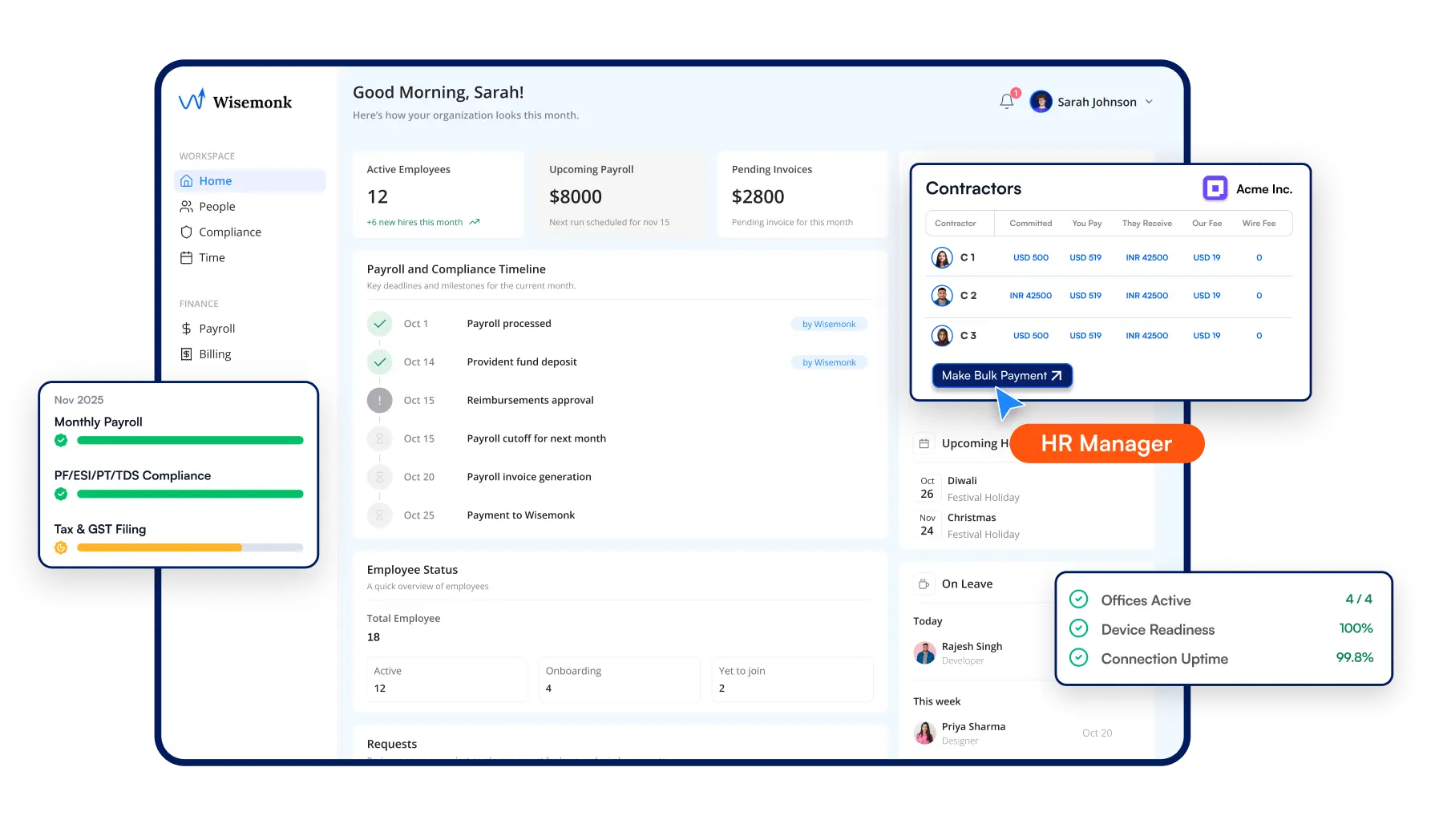
Wir sind der legale Arbeitgeber in Indien für über 300 globale Unternehmen und verwalten mehr als 2.000 Mitarbeiter in allen Bundesstaaten. Von der Ausarbeitung gesetzeskonformer Arbeitsverträge bis Durchführung der Gehaltsabrechnung, die Einreichung von TDS, die Verwaltung der Beiträge zur Vorsorgekasse und der staatlichen Arbeitnehmerversicherung sowie die Verwaltung der Sozialleistungen — wir sind für den gesamten Compliance-Stack zuständig, sodass Sie sich auf den Aufbau Ihres Teams konzentrieren können.
Was du mit Wisemonk EOR bekommst:
- Onboarding in weniger als 3 Tagen: Arbeitsverträge, gesetzliche Registrierungen, Dokumentensammlung und IT-Einrichtung — alles vor dem ersten Tag.
- Vollständige Gehaltsabrechnung: Gehaltsauszahlung, TDS-Einzahlungen, EPF/ESI-Überweisungen, Gewerbesteuer und Ausstellung des Formulars 16, jede Frist, jeden Monat.
- Vollständige Einhaltung gesetzlicher Vorschriften: Staatliche Arbeitsgesetze, Arbeitsgesetzbücher, POSH-Einrichtung, Kündigungsverfahren und Trinkgelder, die in allen indischen Bundesstaaten abgedeckt sind.
- Transparente Preisgestaltung: Ab 99 USD/Mitarbeiter/Monat. Keine versteckten Gebühren, keine FX-Aufschläge.
Egal, ob Sie Ihren ersten indischen Mitarbeiter einstellen oder auf 50 Jahre skalieren, Sie sollten kein Experte für indisches Arbeitsrecht werden müssen, um es richtig zu machen.
Sprechen Sie noch heute mit uns und nehmen Sie ab dieser Woche konform Ihr indisches Team auf.
Häufig gestellte Fragen
Kann ein ausländisches Unternehmen indische Mitarbeiter in USD statt in indischen Rupien bezahlen?
Nein. Gemäß dem indischen Foreign Exchange Management Act (FEMA) müssen Mitarbeiter in Indien in indischen Rupien (INR) bezahlt werden. Auch wenn der Arbeitsvertrag einen USD-Betrag ausweist, muss die endgültige Gehaltsauszahlung in INR über ein lokales Bankkonto erfolgen. Die direkte Zahlung in USD an einen in Indien ansässigen Mitarbeiter verstößt gegen die FEMA-Vorschriften. Unabhängige Auftragnehmer können jedoch unter bestimmten Bedingungen Zahlungen in Fremdwährung erhalten.
Gelten indische Arbeitsgesetze für ausländische Talente, die für ein Unternehmen ohne lokale Niederlassung in Indien arbeiten?
Ja, das tun sie. Das indische Arbeitsrecht hängt davon ab, wo der Arbeitnehmer arbeitet, nicht daran, wo der Arbeitgeber ansässig ist. Wenn Ihr Arbeitnehmer in Indien sitzt, gelten alle gesetzlichen Leistungen, Mindestlöhne, Arbeitszeiten, Mutterschaftsurlaub und Steuerpflichten in vollem Umfang. Aus diesem Grund gründen die meisten ausländischen Arbeitgeber entweder eine juristische Person oder arbeiten mit einem eingetragenen Arbeitgeber zusammen, um die lokalen Arbeitsgesetze einzuhalten.
Was passiert, wenn die Probezeit eines Mitarbeiters endet, aber kein Bestätigungsschreiben ausgestellt wird?
Dies ist ein häufiger und kostspieliger Fehler. Nach indischem Recht kann ein Arbeitnehmer, der über die Probezeit hinaus ohne eine formelle Bestätigung oder Verlängerung weiterarbeitet, als standardmäßig bestätigt gelten. Das bedeutet, dass die volle Verantwortung des Arbeitgebers in Kraft tritt, einschließlich längerer Kündigungsfristen, Kündigungsverfahren aufgrund von Gründen und Anspruch auf Abfindungszahlungen gemäß dem Arbeitsbeziehungsgesetz.
Dürfen indische Arbeitnehmer Gewerkschaften beitreten, und wie wirkt sich das auf ausländische Arbeitgeber aus?
Ja. Indische Arbeitnehmer haben gemäß dem Trade Unions Act von 1926 und dem Industrial Relations Code das gesetzliche Recht, Gewerkschaften beizutreten. Während Gewerkschaftsaktivitäten im verarbeitenden Gewerbe und im öffentlichen Sektor üblicher sind, können auch Beschäftigte im privaten Sektor von Technologie- oder Dienstleistungsunternehmen Gewerkschaften gründen oder ihnen beitreten. Ausländische Arbeitgeber sollten klare betriebliche Richtlinien haben, die dieses Recht respektieren und gleichzeitig offene Kommunikationskanäle aufrechterhalten, um die Anliegen der Arbeitnehmer proaktiv auszuräumen.
Ist eine Krankenversicherung für Arbeitnehmer in Indien obligatorisch oder optional?
Die Gruppenkrankenversicherung ist technisch gesehen nicht durch ein einziges zentrales Gesetz für alle Arbeitgeber des privaten Sektors vorgeschrieben. Nach den neuen Arbeitsgesetzbüchern und dem Gesetz über Sicherheit, Gesundheitsschutz und Arbeitsbedingungen bei der Arbeit müssen Arbeitgeber jedoch Arbeitnehmern über 40 Jahren den Zugang zur grundlegenden Gesundheitsversorgung und jährliche Gesundheitsuntersuchungen ermöglichen. In der Praxis hat sich die Gruppenkrankenversicherung in der indischen Privatwirtschaft zu einer Standardleistung der Arbeitgeber entwickelt, und wenn Sie sie nicht anbieten, sind Sie ernsthaft benachteiligt, wenn es darum geht, qualifizierte Arbeitskräfte anzuwerben.
Wie lange dauert es in der Regel, einen indischen Mitarbeiter von der Angebotsannahme bis zum ersten Tag vollständig an Bord zu nehmen?
Wenn Sie einen registrierten Arbeitgeber beauftragen, kann der gesamte Preboarding- und Onboarding-Prozess innerhalb von 5 bis 7 Werktagen abgeschlossen werden. Wenn Sie die Gründung über Ihre eigene lokale Niederlassung vornehmen, sollten Sie nur 4 bis 8 Wochen für die Registrierung des Unternehmens und die gesetzlichen Registrierungen (PAN, TAN, EPF, ESI) einplanen, bevor Sie überhaupt mit dem Einstellungsprozess beginnen können. Die Hintergrundüberprüfung in Indien dauert in der Regel 7 bis 15 Tage, abhängig vom Umfang der Prüfungen und davon, ob Automatisierungstools verwendet werden.
Was ist der Unterschied zwischen einer Lohnperiode und einer Lohnperiode in den indischen Lohngesetzen?
Gemäß dem indischen Lohnkodex ist eine Lohnperiode das Intervall, für das die Löhne berechnet werden, und darf einen Monat nicht überschreiten. Das bedeutet, dass Arbeitgeber ihre Arbeitnehmer mindestens einmal im Monat bezahlen müssen. Die Lohnperiode bezieht sich auf das tatsächliche Datum, bis zu dem das Gehalt ausgezahlt werden muss. Dies ist in der Regel der letzte Arbeitstag des Monats oder der 7. des Folgemonats für Unternehmen mit weniger als 1.000 Arbeitnehmern. Die Nichteinhaltung der Frist für die Lohnperiode stellt einen Verstoß gegen die Vorschriften dar und kann zu Strafen sowohl nach den zentralen als auch nach den staatlichen Arbeitsgesetzen führen.

.png)











.webp)
.webp)


.webp)
.webp)
.webp)

.webp)
.webp)

.webp)


.webp)

.webp)

.webp)


.webp)

.webp)

.webp)

.webp)

.webp)




.webp)
.webp)

%20Explained.webp)

.webp)



%20(1).webp)

.webp)

%20in%20India%20(2024).webp)

.webp)
.webp)
.webp)


%20(1).webp)




%201.webp)


%20in%20India.webp)

%20(1).webp)


.webp)

.webp)
.webp)
.webp)